

From Approved Sample to Commercial Production
A bath bomb may look like a simple compressed product, but producing it consistently at commercial scale requires control at every stage of manufacturing.
Once the formula, fragrance, color, shape and packaging have been approved, the challenge changes. The goal is no longer to create one good sample. It is to reproduce that approved product across a full production batch while maintaining consistent weight, structure, appearance and performance.
Small changes in raw material condition, moisture, mixing, molding or drying can affect the finished bath bomb. For private label brands, understanding the manufacturing process makes it easier to evaluate production quality and work effectively with an OEM partner. For a broader view of product development, see our Private Label Bath Bombs Guide.
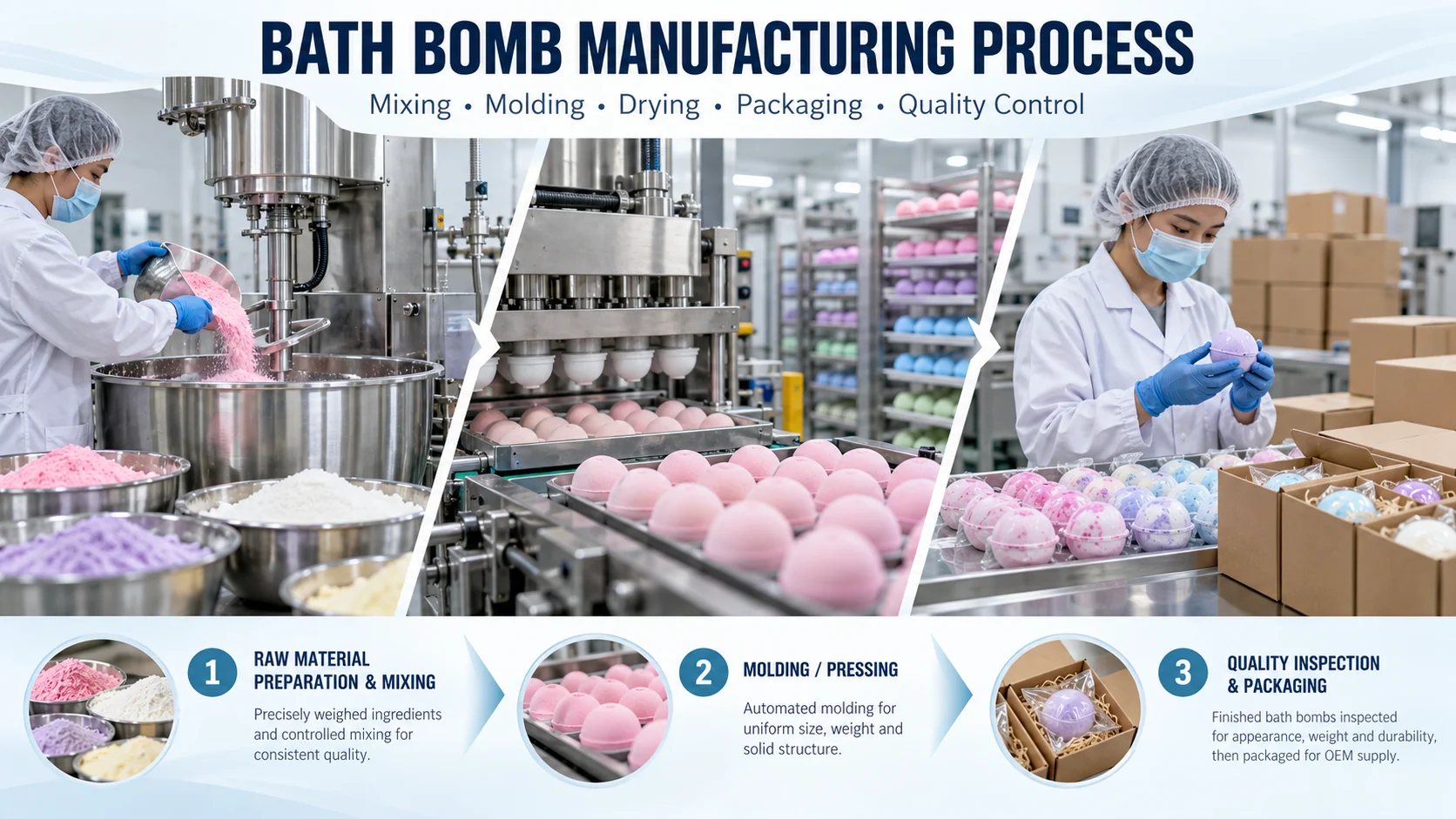
A typical commercial bath bomb manufacturing process moves from an approved specification through raw material preparation, mixing, molding, drying, quality inspection and final packaging.
Confirm the Approved Product Before Production
Commercial production should begin from a clearly approved product specification.
Before materials are prepared, the production team needs a defined reference for the bath bomb formula, fragrance, color, finished weight, dimensions, mold and packaging requirements. If the product includes a specific visual effect or decorative finish, that should also be confirmed during sampling.
The approved sample becomes an important production reference. It allows the factory to compare the commercial batch against the product that the brand has already accepted.
This is particularly important for customized bath bombs because several development decisions are connected. A change in formula can affect molding behavior, while a change in size or shape may influence drying and packaging fit.
By confirming these details before production begins, the manufacturer can reduce unnecessary adjustments once a batch is already in process.
Raw Material Preparation and Batch Control
Consistent production starts before the ingredients reach the mixer.
Raw materials need to be prepared according to the approved formulation, with attention to material condition, weighing accuracy and batch identification. Moisture-sensitive ingredients require particular care because unwanted moisture can affect the bath bomb before molding even begins.
For commercial production, repeatability matters more than simply following an ingredient list. The same raw materials need to be handled in a controlled way from one batch to the next so that changes in texture, fragrance or product structure are kept within the approved range.
Clear batch records also make it easier to trace production if an issue appears later during quality inspection.
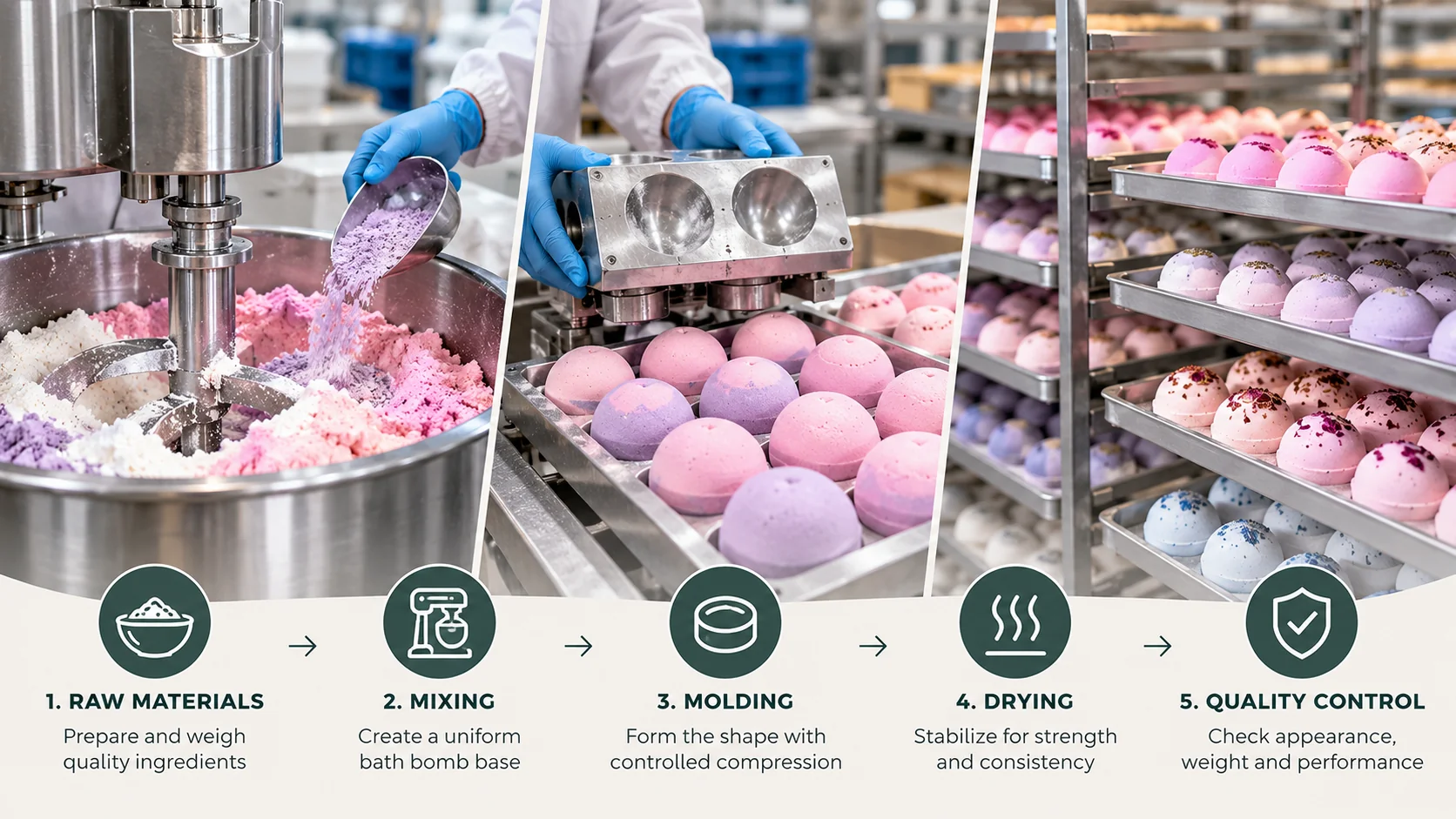
Mixing: Creating a Uniform Bath Bomb Base
Mixing is one of the most important stages in the bath bomb manufacturing process.
The dry components need to be distributed evenly before fragrance, oils, color systems or other formula components are incorporated. Uneven mixing can lead to visible color differences, inconsistent fragrance or variations in fizz performance between products from the same batch.
Moisture also needs to be carefully managed. Too much moisture during processing can affect the mixture before molding, while insufficient binding can make the finished product more fragile.
The objective is not simply to combine all ingredients. The mixture needs to reach a condition that can be molded consistently while still maintaining the performance of the approved formula.
For custom products, this stage becomes even more important when the formula contains several colors, botanical ingredients or decorative components.
Molding: Controlling Shape, Density and Structural Strength
After mixing, the bath bomb mixture is formed into the approved shape.
Molding affects much more than appearance. Compression and mold conditions influence product density, edge definition and structural strength.
If compression is insufficient, the bath bomb may be too fragile for handling and transportation. If the product becomes excessively dense, the final dissolution experience may differ from the approved sample.
Custom molds can introduce additional considerations. Fine details, raised patterns and unusual edges need to release cleanly while remaining strong enough to survive subsequent drying and packaging.
For this reason, the molding stage needs to work together with the approved formula rather than being treated as a separate design step.
The production goal is simple: each piece should remain close to the approved weight, dimensions and visual standard while moving efficiently through the manufacturing line.
Drying and Stabilization Before Packaging
Bath bombs are not normally ready for final packaging immediately after molding.
They need time under controlled conditions to develop sufficient structural stability before further handling. This stage helps reduce residual moisture and allows the product to reach the level of hardness required for inspection and packing.
Drying conditions can influence both appearance and performance.
If the product does not stabilize sufficiently, it may be more vulnerable to cracking, deformation or moisture-related problems during storage. Inconsistent drying can also create differences between batches or between products within the same batch.
The exact drying period should not be treated as a universal number. It depends on factors such as formula, product size, shape and production environment.
What matters for commercial manufacturing is that the product reaches the approved condition before it moves into final inspection and packaging.
Quality Control During Bath Bomb Production
Quality control should take place throughout production rather than only after the entire batch has been completed.
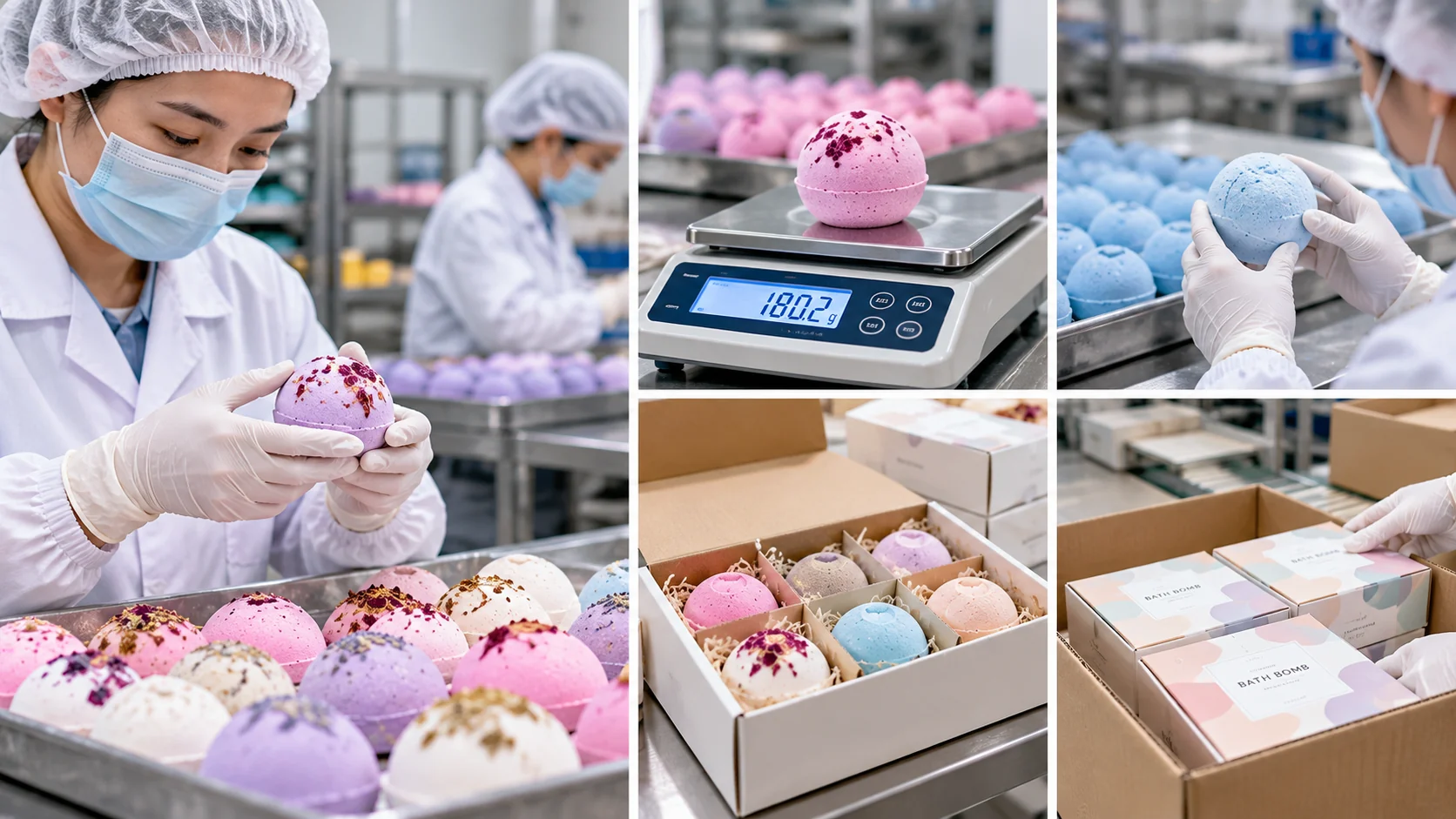
Early checks can identify problems before they affect a large quantity of finished products. During production, manufacturers may review raw material condition, mixture uniformity, molded weight, structural strength and visible appearance.
Finished products can then be compared against the approved sample for appearance, fragrance, product structure and use performance.
Bath Bomb Quality Control Checkpoints
| Production Stage | What Is Checked | Why It Matters |
|---|---|---|
| Raw Materials | Material condition and batch information | Supports production consistency and traceability |
| Mixing | Uniformity and moisture condition | Helps control color, structure and performance |
| Molding | Weight, shape and structural definition | Reduces variation and breakage |
| Drying | Hardness and surface condition | Supports handling and storage stability |
| Finished Product | Appearance, fragrance and performance | Confirms alignment with the approved sample |
| Packaging | Product fit, closure and final condition | Protects the product during distribution |
A quality system is most useful when the production standard is clear. Rather than deciding whether a bath bomb "looks good," the team should be comparing it against agreed specifications and approved samples.
Packaging After Product Inspection
Packaging is one of the final controlled steps in the manufacturing process.
At this stage, products that meet the required specifications are prepared according to the approved packaging plan. The focus is no longer on choosing between wraps, boxes or tubes; those decisions should already have been made during product development.
Instead, production teams need to confirm that the correct packaging materials are being used, that each bath bomb fits properly, and that labels, inserts and outer cartons match the approved order.
For moisture-sensitive bath bombs, seal quality and product protection remain particularly important.
Final inspection should also confirm that the product has not been damaged during packing and that the finished units are ready for storage and shipment.
From Small Samples to Commercial-Scale Production
Scaling a bath bomb from development samples to commercial production is not simply a matter of making a larger batch.
A formula that performs well during sampling still needs to work reliably with commercial equipment, larger mixing volumes and normal production conditions.
At scale, small differences that were difficult to notice during sample development may become more visible. Color distribution, moisture balance, compression consistency or decorative details can all behave differently when hundreds or thousands of pieces are produced.
This is why scale-up is an important part of OEM manufacturing.
The objective is to reproduce the approved sample reliably rather than redesigning the product during production. In some projects, minor process adjustments may be necessary to maintain the intended appearance and performance at a larger scale.
Those adjustments should preserve the approved product concept while improving production repeatability.
Common Bath Bomb Manufacturing Issues
Most production problems are not caused by one stage in isolation. Bath bomb manufacturing is a connected system, and an issue visible at the end of production may have started much earlier.
| Manufacturing Issue | Possible Production Area |
|---|---|
| Cracking or breakage | Moisture balance, molding or drying |
| Uneven color | Mixing or color distribution |
| Weak structure | Formula balance or compression |
| Inconsistent fizz | Mixing, moisture or storage conditions |
| Shipping damage | Product hardness or packaging protection |
For example, cracking may look like a packaging problem when the actual cause is insufficient structural strength. Uneven fizz may appear to be purely a formula issue but can also be influenced by mixing or moisture exposure during production.
This is why troubleshooting should consider the complete manufacturing process rather than focusing on one symptom alone.
Why Manufacturing Experience Matters for Private Label Bath Bombs
Private label bath bomb production brings together formulation, design, manufacturing, quality control and packaging.
An OEM partner needs to understand how decisions made during product development affect the factory floor. A custom shape may require different molding conditions, while a moisture-sensitive formula may need additional attention during production and packing.
POLEVIEW has long provided bath bomb R&D, product design, production and OEM/ODM support, together with packaging and testing coordination. The original manufacturing page already reflected these capabilities, although the previous article did not explain the production process in detail.
For projects requiring documented manufacturing controls, Poleview's current certification information includes ISO 22716 and GMPC, both of which relate to controlled cosmetic manufacturing and quality procedures.
The value of an experienced manufacturing partner is therefore not simply production capacity. It is the ability to connect an approved product specification with repeatable commercial production.
FAQ About Bath Bomb Manufacturing
Q: 1. How are bath bombs manufactured at commercial scale?
A: The process typically includes approved specification confirmation, raw material preparation, controlled mixing, molding, drying or stabilization, quality inspection and packaging. Each stage needs to remain consistent with the approved product standard.
Q: 2. How long do bath bombs need to dry before packaging?
A: There is no single drying time that applies to every bath bomb. Formula composition, size, shape and production conditions all influence how long the product needs to stabilize before packaging.
Q: 3. How do manufacturers control bath bomb hardness?
A: Hardness is influenced by the formula, moisture condition, molding pressure and drying process. Manufacturers evaluate these factors together rather than relying on compression alone.
Q: 4. What quality checks are performed before bath bombs are shipped?
A: Checks may include product weight, appearance, structural condition, fragrance consistency, performance and packaging integrity. The finished production batch should remain aligned with the approved specification.
Manufacture Private Label Bath Bombs with POLEVIEW
Moving from an approved sample to commercial production requires more than increasing batch size. Mixing, molding, drying, quality control and packaging all need to work together to maintain a consistent finished product.
POLEVIEW supports private label and OEM bath bomb projects from product development through manufacturing and packing. Our goal is to help brands move from approved concepts to reliable commercial production while maintaining the product characteristics established during development.