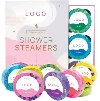


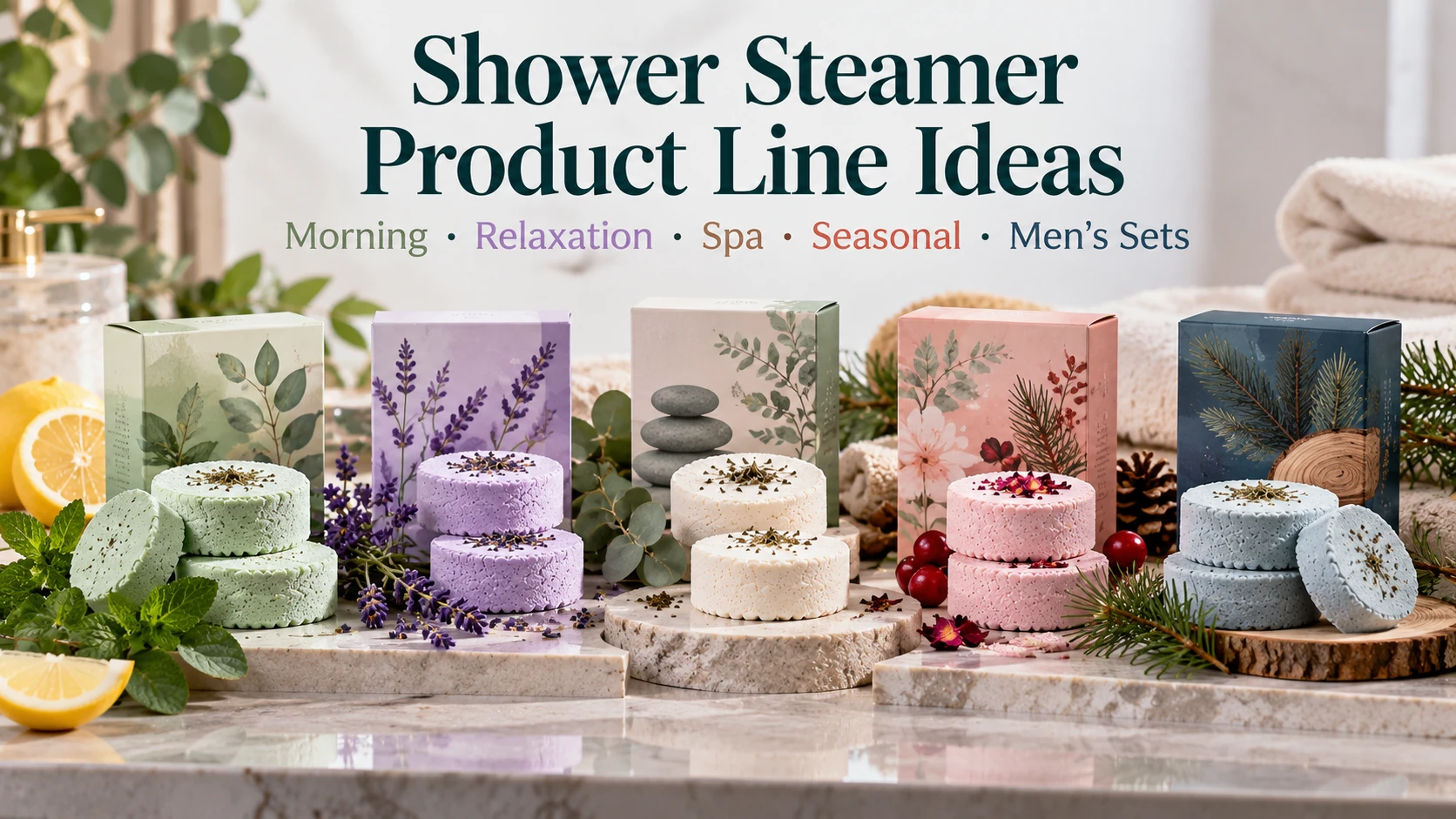
A shower steamer product line becomes difficult to manage when every new fragrance is treated as a new product idea.
A stronger portfolio gives each SKU a clear reason to exist. One product may act as the easiest entry point for new customers. Another adds a softer fragrance direction. A premium SKU can raise the overall positioning of the collection, while seasonal products create freshness without permanently increasing the size of the range.
For private label brands, the goal is therefore not to launch as many shower steamers as possible.
It is to build a collection that customers can understand, retailers can merchandise and the manufacturer can reproduce efficiently.
Morning, relaxation, spa, seasonal and men's or unisex concepts can all fit within the same shower steamer platform, but they should play different roles rather than simply repeat similar fragrances under different names.
This guide looks at how to structure those roles and build a shower steamer product line that can expand without becoming repetitive or unnecessarily complex.
For the broader development process, see our Private Label Shower Steamers Guide.
1. What Makes a Balanced Shower Steamer Product Line?
A balanced product line is not defined by the number of SKUs.
It is defined by how clearly those SKUs differ from one another.
A useful portfolio normally includes several different roles.
The hero SKU is the easiest product to understand and often becomes the main entry point into the range.
Supporting SKUs add contrast rather than competing directly with the hero product.
A premium or spa-oriented SKU gives the collection another level of perceived value.
Seasonal products create short-term freshness and give the brand a controlled way to test new ideas.
Audience-specific products, such as men's or unisex fresh-woody collections, can expand the range when the sales channel or target customer justifies them.
The key is that each product adds a new reason to buy.
If five fragrances all create almost the same fresh herbal impression, the brand may technically have five SKUs but only one meaningful product position.
That makes the collection harder to merchandise, harder to forecast and more complicated to produce.
| Portfolio Role | Main Purpose | Example Direction |
|---|---|---|
| Hero SKU | Easy to understand and broadly relevant | Fresh eucalyptus or eucalyptus-mint |
| Supporting SKU | Adds fragrance or occasion contrast | Lavender, citrus or softer aromatic profile |
| Premium SKU | Raises the collection tier | Layered spa, herbal or woody blend |
| Seasonal SKU | Tests new ideas and creates limited-time interest | Holiday, summer or floral concept |
| Audience SKU | Supports a specific channel or positioning | Men's / unisex fresh-woody range |
This framework is more useful than beginning with a long fragrance list.
2. Give Every SKU a Clear Role
Before naming a new product, ask what it contributes to the range.
Does it attract a different customer?
Does it create a different use occasion?
Does it give the retailer a new merchandising story?
Does it move the brand into a more premium tier?
Or is it simply another fragrance that behaves almost exactly like an existing SKU?
That last question matters.
Internal competition can happen inside a product line just as easily as it happens between brands.
For example, eucalyptus, eucalyptus-mint, eucalyptus-rosemary and mint-citrus may all sound different on paper. If they create a very similar fresh experience in actual use, customers may not understand why they need more than one of them.
A new SKU should therefore add meaningful contrast, not simply another fragrance name.
This becomes even more important for private label brands with limited initial order quantities or packaging budgets.
Every extra SKU introduces another fragrance sample, artwork version, packaging component, QC reference and reorder forecast.
Portfolio clarity has operational value as well as marketing value.
3. Morning Collection: Build a Bright Everyday Entry Point
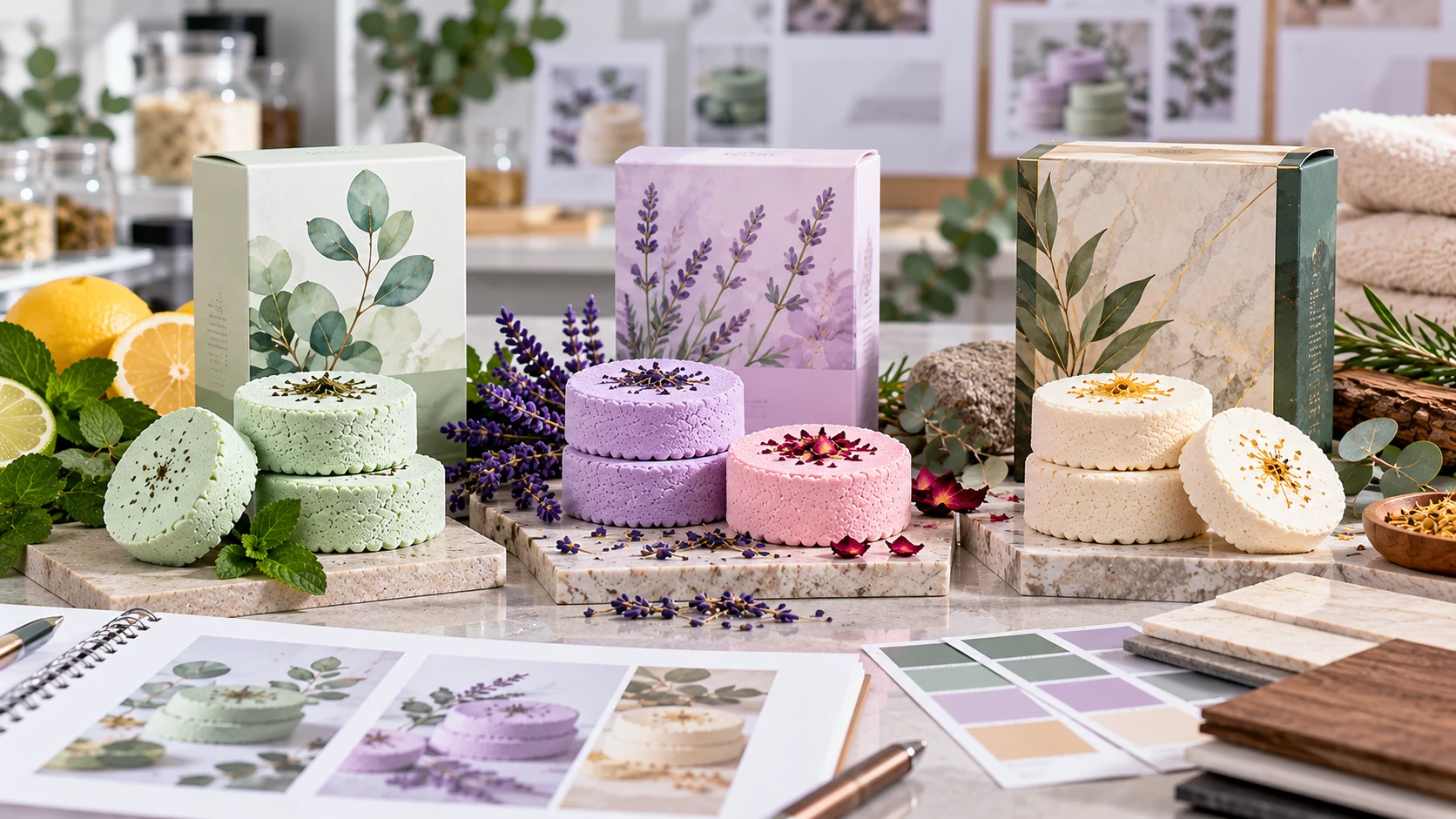
A morning-oriented SKU can work well as a broad entry product because the concept is immediately understandable.
The positioning should stay sensory rather than therapeutic.
A "Morning Energy" concept does not need to claim that the product increases energy or improves focus. It can simply be built around bright, fresh and aromatic fragrance character that suits a morning shower routine.
Fresh herbal and citrus directions often fit this role well.
Eucalyptus, mint, lemon or rosemary-inspired blends can create a product that feels clean and direct without requiring a complicated explanation.
From a portfolio perspective, the important question is whether the morning SKU is distinct enough from the rest of the collection.
If the spa SKU also uses eucalyptus and mint, and the men's SKU uses eucalyptus and menthol, all three products may begin to overlap.
The morning product should therefore be evaluated as part of the full line, not in isolation.
For deeper guidance on eucalyptus, lavender, menthol and custom fragrance architecture, see our Aromatherapy Shower Steamers Guide.
4. Relaxation Collection: Create a Softer Counterpoint
A relaxation-oriented shower steamer can give the range useful contrast.
If the hero SKU is bright and fresh, the relaxation SKU can shift the collection toward a softer aromatic direction.
Lavender is an obvious starting point because the fragrance is widely recognized, but the product does not need to rely on a generic single-note profile.
Supporting notes can make the SKU feel more distinctive.
A softer botanical structure may create a spa-like direction, while a warmer woody or vanilla-style base can move the product toward evening gifting or premium self-care positioning.
The important point is not to promise therapeutic effects.
Terms such as:
evening-inspired
soft aromatic
spa-like
slow shower ritual
can communicate positioning without claiming to treat anxiety, insomnia or other medical conditions.
Within the product line, this SKU should act as a clear counterpoint to the fresh morning direction.
If customers cannot immediately understand the difference between the two, the assortment needs more separation.
5. Spa Collection: Create a Premium Tier
A spa collection should do more than add the word "spa" to an existing fragrance.
Its role in the portfolio is usually to create a more premium tier.
That can come from a more layered fragrance structure, a more restrained visual identity, a distinctive tablet format or stronger gift-set potential.
A spa SKU may also become the collection most suitable for hospitality, boutique retail or wellness gifting.
This does not mean the formula needs to be completely different from every other product.
In many cases, the brand can use the same manufacturing platform while changing the fragrance architecture, appearance and presentation enough to create a clearly different product experience.
The benefit of this approach is operational.
The brand gains a premium product without building an entirely separate manufacturing system.
A well-developed spa SKU can also act as an anchor for future gift sets because it already carries a more elevated fragrance and presentation story.
A well-developed spa SKU can also act as an anchor for future shower steamer gift sets because it already carries a more elevated fragrance and presentation story.
6. Seasonal Collections: Use Limited Editions to Test Demand
Seasonal shower steamers should not exist only because a holiday is approaching.
They can also act as controlled product tests.
A limited fragrance gives the brand a way to introduce something different without immediately turning it into a permanent inventory commitment.
If the SKU performs well across the season and generates strong reorder interest, the brand can consider bringing it into the evergreen range.
If performance is weak, the concept can be retired without creating permanent portfolio complexity.
This makes seasonal products useful for testing:
new fragrance families,
different color directions,
new gift-set themes,
and channel-specific concepts.
The important operational decision is how much of the product becomes seasonal.
A brand does not necessarily need a completely new formula, mold, box, insert and wrapper for every campaign.
Keeping the core product or packaging structure consistent while changing visible seasonal elements can make the program easier to manage and reorder.
Seasonal launches work best when they add temporary interest without turning the entire product system into a temporary one.
7. Men's and Unisex Fresh-Woody Collections
A men's shower steamer line can be useful when it reflects an actual channel or brand opportunity.
It should not be created simply because "men prefer dark packaging and woody scents."
That type of assumption can lead to a stereotyped range rather than a well-defined product.
For brands targeting men's grooming or broader unisex wellness positioning, fresh herbal, mint, citrus, cedar, pine or other woody directions can be explored.
The visual identity may also become more restrained, but the product still needs to fit the brand rather than follow a generic "men's" design formula.
A men's or unisex SKU should answer a specific portfolio question:
Does it open a new retail channel?
Does it support an existing men's grooming range?
Does it give gift buyers a different option?
Does it create a fragrance direction that is missing from the current collection?
If the answer is no, adding the SKU may simply increase inventory complexity without adding much commercial value.
8. Avoid SKU Cannibalization
Product-line expansion is useful only when the new products are clearly different enough to earn their place.
SKU cannibalization begins when several products compete for the same customer, fragrance expectation and purchase occasion.
Consider a hypothetical range containing:
Eucalyptus
Eucalyptus + Mint
Mint + Eucalyptus
Eucalyptus + Rosemary
Menthol + Eucalyptus
That is five SKUs.
But from a customer perspective, the collection may still feel like one fresh herbal idea repeated five times.
This creates several problems.
Retailers have more products to explain.
The brand needs more artwork and packaging.
The manufacturer manages more fragrance versions and QC references.
Inventory is spread across more items.
Reorder demand becomes harder to forecast.
The solution is not necessarily to eliminate similar fragrance families entirely.
It is to make sure each SKU has a distinct role.
One might be the broad fresh hero product. Another could be a higher-impact menthol concept. A third may move into a woody spa direction.
Once the role is clear, the fragrance can be designed around it.
9. More SKUs Create More Production Complexity
Adding a SKU affects more than the website product list.
Each new variation can introduce:
a new fragrance sample,
a new approved reference,
new artwork,
different labels or cartons,
additional packaging inventory,
production changeovers,
QC references,
and separate reorder forecasting.
That is why a ten-SKU launch is not simply twice as complex as a five-SKU launch.
Dependencies begin to multiply.
One fragrance may require different packaging artwork. Another may use a different color. A seasonal product may introduce a new sleeve, while another SKU may require a different carton or shower steamer packaging structure.
The brand then needs to coordinate all of those components at the same time.
For private label projects, this is one reason a focused launch can be more useful than a broad launch built mainly to make the catalog look complete.
Customization should be concentrated on the parts customers notice and value.
Less visible components can often remain standardized when doing so improves production consistency and reorder reliability.
This is especially important when the brand expects to expand quickly after launch.
10. Launch the Core Range First, Then Expand With Evidence
A product line does not need to reach its final size on launch day.
A more controlled strategy is to expand in stages.
Phase 1 - Core Range
Begin with a small set of clearly different roles.
That might include:
a broad hero product,
a softer contrasting SKU,
and a premium or spa-oriented product.
The exact number is less important than the clarity of the range.
Phase 2 - Channel Expansion
Once the brand understands which products generate demand, it can add gift sets, premium spa products or audience-specific SKUs that support actual sales channels.
Phase 3 - Seasonal Testing
Limited launches can then be used to test new fragrance families or visual concepts without committing them immediately to the permanent line.
Expansion decisions should follow evidence such as:
sell-through,
reorder patterns,
channel feedback,
customer fragrance preferences,
and operational performance.
Brainstorming can create new ideas.
Reorder data tells the brand which ideas deserve to stay.
11. Product Line Planning Matrix
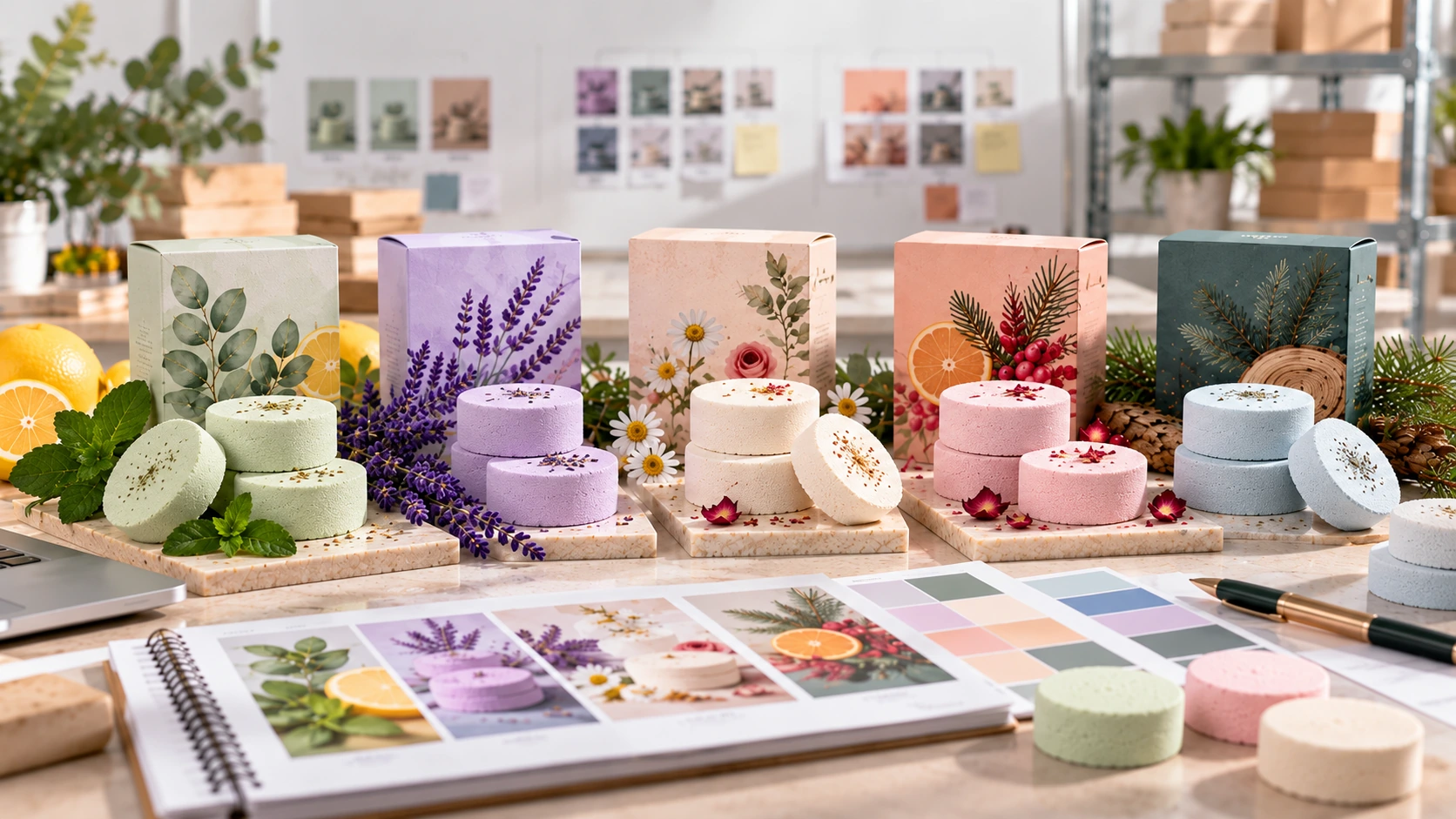
The following framework shows how the five concepts in this guide can play different roles inside one portfolio.
| Collection | Role in the Portfolio | Main Decision |
|---|---|---|
| Morning | Broad everyday entry point | Is the fresh direction clearly different from Spa or Men's? |
| Relaxation | Softer fragrance contrast | Does it create enough separation from the premium Spa SKU? |
| Spa | Premium tier | Is the scent and presentation distinctive enough to justify the role? |
| Seasonal | Limited test and promotional refresh | Can the concept be launched without creating excessive permanent inventory? |
| Men's / Unisex | Audience or channel expansion | Is the SKU driven by real channel demand rather than stereotype? |
The matrix is not a fixed launch template.
A brand may use only three of these roles initially.
Another may launch directly with a spa-led collection because that better matches its existing customers.
The important point is that each SKU serves a deliberate purpose.
12. Keep Formula, Fragrance and Packaging Connected
Portfolio planning does not replace technical product development.
A brand may create a strong five-SKU strategy and still struggle if the tablets do not perform consistently across fragrances or if the packaging becomes too complicated to manage.
Different fragrances can behave differently in the finished tablet.
Different colors or molds may affect production.
Seasonal sleeves and gift boxes create additional packaging components.
A new tablet format can require new packaging dimensions.
For this reason, product-line architecture should be shared with the manufacturer early rather than developed only as a marketing document.
The private label shower steamer manufacturer should understand which components can remain standardized and which SKUs require genuine technical or packaging differences.
For detailed technical development, see our Shower Steamer Formula Guide.
13. How to Know When a Product Line Is Ready to Expand
A product line is ready to expand when the new SKU solves a real portfolio need.
Useful signals may include:
customers repeatedly asking for another fragrance direction,
a hero scent generating strong reorder demand,
a retailer requesting a premium or seasonal extension,
gift-set performance showing demand for a particular fragrance,
or an existing seasonal SKU performing strongly enough to justify permanent status.
Expansion is less convincing when the main reason is simply:
"We only have five products and competitors have ten."
Competitor catalog size does not tell you whether those products are all commercially useful.
The goal should be to create a portfolio that becomes easier to understand as it grows, not harder.
Frequently Asked Questions About Shower Steamer Product Line Planning
Q: 1. How many SKUs should a new shower steamer line launch?
A: There is no universal ideal number. The right range depends on sales channel, order size, packaging complexity and how clearly the products differ from one another. A focused collection with distinct roles can be stronger than a larger range of similar fragrances.
Q: 2. How do I know whether two shower steamer SKUs are too similar?
A: Compare the fragrance experience, positioning and buying occasion. If both products target the same customer, use the same fragrance family and communicate nearly the same benefit, they may be competing for the same role within the portfolio.
Q: 3. Should seasonal shower steamers use completely different formulas?
A: Not necessarily. A seasonal concept can sometimes use an established product platform with changes to fragrance, color or visible packaging elements. Any change still needs to be reviewed in the finished product.
Q: 4. When should a seasonal fragrance become part of the permanent line?
A: Consider moving it into the evergreen assortment when repeated seasonal performance, customer response or reorder demand shows that the fragrance has value beyond the original campaign.
Q: 5. Does a men's shower steamer range need a completely different formula?
A: Not automatically. The difference may come primarily from fragrance direction, visual identity or channel positioning. Formula changes should be driven by the intended product performance rather than the audience label alone.
Q: 6. How can brands expand without making packaging and inventory too complex?
A: Standardize components that customers do not need to see as unique, and customize the parts that create visible product value. Reusable structural packaging, shared tablet formats and controlled fragrance architecture can make expansion easier to manage.
Build a Shower Steamer Range That Can Grow
A strong shower steamer product line gives every SKU a reason to exist.
Start with a clear core range. Use supporting products to create meaningful contrast, premium products to broaden positioning and seasonal launches to test new demand without adding unnecessary permanent complexity.
The objective is not the largest catalog.
It is a collection that customers can understand, retailers can merchandise and the manufacturer can reproduce reliably as the brand grows.
If your brand already has a target market, fragrance direction or initial SKU concept, the next step is to turn those ideas into a practical product-line brief before sampling begins.
Poleview supports private label shower steamers across product planning, fragrance development, formula development, packaging and commercial production.
Discuss Your Product Line Plan