

Choosing the right private label shampoo bar manufacturer is one of the most important decisions a brand will make when developing a solid hair care line.
A shampoo bar may look simple from the outside, but the product depends on many technical details: the cleansing system, conditioning level, bar hardness, pH direction, fragrance stability, color consistency, drying behavior and packaging fit. A sample that looks good on the first day may become too soft after repeated use. A bar that foams well in a quick lab test may not rinse cleanly in real consumer use. A box that looks premium in photos may not protect the product during export shipping.
For this reason, brands should not choose a shampoo bar supplier only because the unit price is low or the first sample looks attractive. The right manufacturing partner should understand your target customer, product positioning, formula direction, packaging channel and quality expectations before recommending a solution.
This guide explains how to evaluate a private label or custom shampoo bar manufacturer and choose a partner that can support your brand from product development to stable commercial production. For a broader overview of formula selection, packaging, sampling and OEM production, read our private label shampoo bar guide before comparing suppliers.
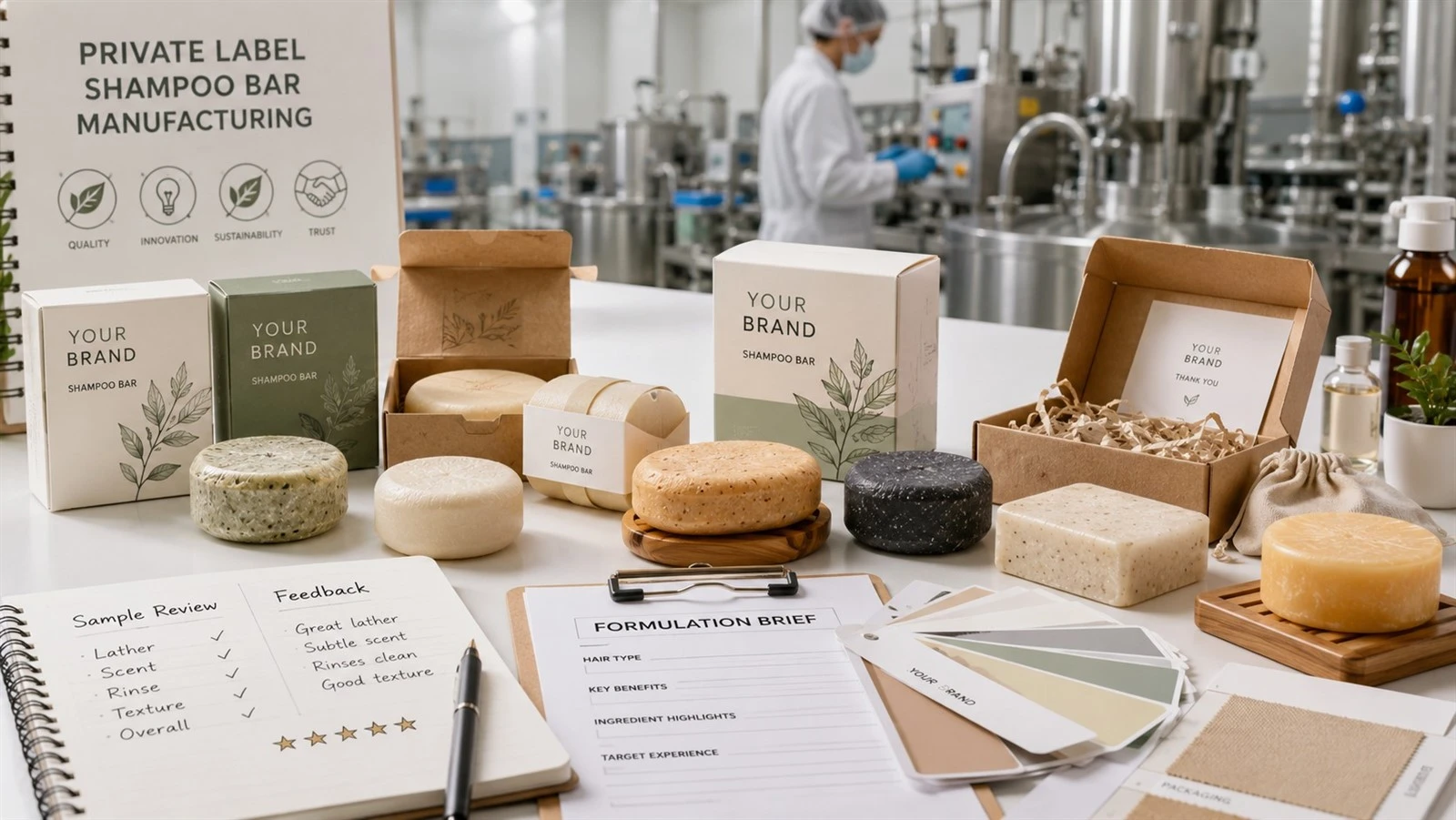
Why Manufacturer Choice Affects More Than Unit Price
Price matters, but it is only one part of supplier selection. A low quotation can become expensive if the formula needs repeated correction, packaging does not fit, documents are incomplete, the shipment arrives damaged or bulk production does not match the approved sample.
A reliable shampoo bar manufacturer should help reduce project risk. That means the supplier should be able to explain formula options, guide sample revisions, control production variables, support packaging decisions and communicate realistic lead times.
For private label brands, the manufacturer affects three key stages.
First, it affects product development. The factory should help translate your product idea into a practical formula, bar size, fragrance direction and packaging plan.
Second, it affects launch readiness. The supplier should support samples, label information, packaging specifications, technical documents and bulk production planning.
Third, it affects long-term reorders. A shampoo bar that performs well in the first order must be reproduced consistently in future batches. Color, fragrance, weight, hardness, dimensions and packaging should remain within agreed limits.
A good shampoo bar manufacturer is not simply a factory that can make solid bars. It is a development partner that understands how formula, process, packaging and quality control work together.
Start with a Clear Shampoo Bar Product Brief
Before contacting manufacturers, define what your brand wants to create. A clear product brief helps the factory recommend a suitable formula, development route, packaging format and production plan.
Your target customer should be the starting point. A clarifying shampoo bar for oily scalp needs a different formula direction from a moisturizing bar for dry hair, a gentle bar for color-treated hair or a smoother-feel bar for curls. A travel-focused shampoo bar may need stronger durability and compact packaging. A salon-style product may require a more refined fragrance and premium retail presentation.
Your price positioning also matters. A mass-market shampoo bar, a premium salon bar and a natural lifestyle bar may use different surfactant systems, fragrances, ingredients, packaging materials and customization levels. Without a clear target retail price, it is difficult to decide how much should be invested in formula development, packaging and testing.
Before asking for a quotation, prepare these details:
- Target market and sales channel
- Target customer and hair type
- Formula direction: soap-based, syndet or undecided
- Fragrance, color and ingredient story
- Bar weight, shape and logo embossing needs
- Packaging preference and sustainability direction
- Estimated order quantity and launch timeline
- Required documents, label information or claim direction
A professional shampoo bar manufacturer should ask these questions before giving a final recommendation. Be cautious if a supplier immediately offers the same standard formula without first understanding your market, sales channel or customer expectations.
Choose the Right Development Route
Not every brand needs full custom development from the first order. Some brands need a fast private label shampoo bar solution to test the market. Others need a semi-custom product with adjusted fragrance, color, ingredient story or packaging. Established brands may need a fully custom shampoo bar formula built around a specific product concept.
The terms private label, OEM and ODM are sometimes used differently by suppliers. Instead of relying only on those words, ask the manufacturer exactly what can be changed.
| Development Route | Best For | What to Confirm |
|---|---|---|
| Ready-made private label | Fast launch, market testing, small product expansion | Formula maturity, available fragrances, standard bar size and packaging options |
| Semi-custom production | Faster differentiation with controlled development time | What can be changed: fragrance, color, extracts, shape, logo and packaging |
| Full custom OEM/ODM | Unique brand concepts or technical product requirements | Development timeline, testing plan, exclusivity, stability checks and cost |
A ready-made formula can reduce development time, but it may offer limited differentiation. Semi-custom development gives the brand more room to adjust the product while using a proven formula base.
Full custom shampoo bar development is more suitable when your brand needs a specific surfactant system, pH direction, hair-type positioning, sensory profile, ingredient restriction, certification direction or exclusive product concept.
Brands comparing ready-made, semi-custom and full custom options can also review Poleview's private label shampoo bar manufacturing support for formula, fragrance, shape, logo embossing and packaging customization.
A capable custom shampoo bar manufacturer should explain which changes are technically practical and which may affect foam, rinse feel, hardness, stability, production efficiency or cost.
Evaluate Shampoo Bar Formulation Knowledge
A factory that produces traditional soap does not automatically have the technical experience needed to manufacture high-performance shampoo bars. Shampoo bars and soap bars may look similar, but their formulation systems and consumer expectations can be very different.
One of the first questions to ask is whether the manufacturer can produce soap-based shampoo bars, syndet shampoo bars or both.
Soap-based shampoo bars are made through a traditional soap-making process and usually support handmade, natural or traditional brand positioning. They can work well for some markets, but they may not match every customer's expectation for hair feel, rinse performance or pH positioning.
Syndet shampoo bars are made with surfactants rather than a conventional soap base. They usually offer more flexibility in cleansing level, foam structure, conditioning support and pH direction. This can make them suitable for brands developing shampoo bars for oily scalp, dry hair, curly hair, color-treated hair or frequent washing. For a deeper SKU planning framework, see our guide on developing shampoo bars for oily scalp, dry hair, curly hair and color-treated hair.
The key question is not which system sounds more natural. The key question is which formula system matches your customer, sales channel and product promise. If your team is still deciding which formula system fits your market, compare both options in our soap-based vs syndet shampoo bars guide.
A reliable shampoo bar manufacturer should also be able to adjust more than fragrance and color. The cleansing system, conditioning level, oils, powders, proteins, botanical extracts and fragrance system should all support the intended product direction.
For example, a shampoo bar for oily scalp may need a clean rinse and lighter conditioning profile. A bar for dry or textured hair may need a milder cleansing system and more support for manageability. A color-care shampoo bar may need a gentler washing profile than a deeply clarifying bar.
Hero ingredients can strengthen the product story, but they cannot fix an unsuitable base formula. Panthenol, rice protein, rosemary extract, argan oil, caffeine, shea butter or botanical extracts only work well when the complete formula is balanced.
A professional shampoo bar factory should be able to explain why each important ingredient is included, rather than simply adding fashionable ingredients to the label.
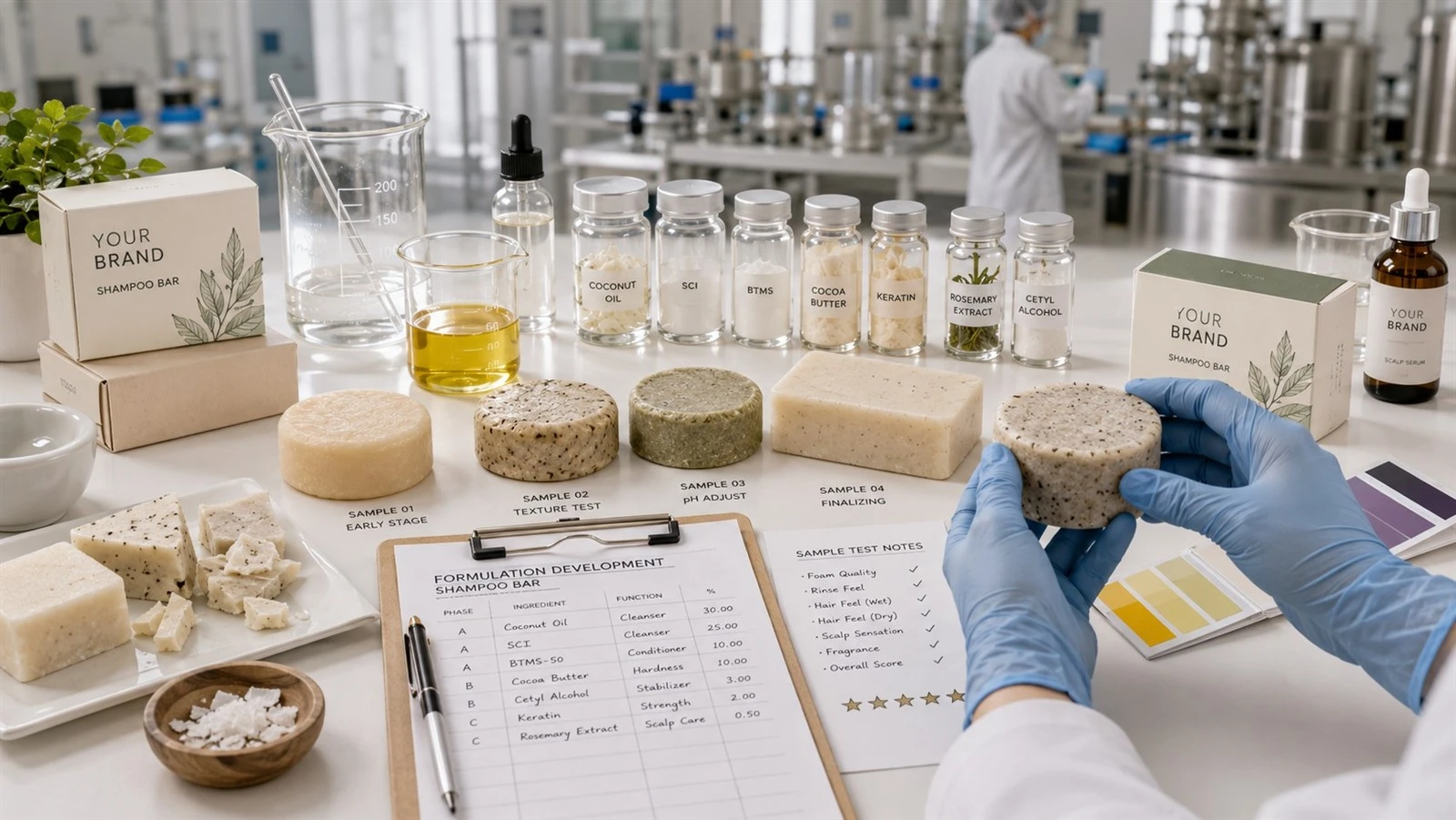
Check the Sample Testing and Revision Process
A shampoo bar sample should not be approved only because it looks good, smells pleasant or produces foam during one quick test. Many performance problems appear only after repeated wetting, drying, storage and use.
During sample testing, brands should evaluate how quickly the bar creates foam, how easily it moves through wet hair, how the scalp and hair feel during rinsing and how the hair feels after drying. A bar may feel smooth in the shower but leave residue, heaviness or excessive dryness later.
The physical condition of the bar also matters. It should maintain acceptable hardness and shape after repeated use. Excessive softening, cracking, crumbling, sweating, sticking or rapid fragrance loss may indicate that the formula, processing conditions or packaging need adjustment.
Samples should also be reviewed under realistic storage conditions. This is especially important for brands importing shampoo bars internationally, where products may experience long transit times, temperature changes and humidity before reaching the final market.
A reliable supplier should welcome detailed feedback and provide a structured revision process. Vague feedback such as "make it better" is difficult for a formulator to use. More specific feedback, such as "reduce drag during application," "improve clean rinse feel," or "increase bar hardness after repeated use," gives the manufacturer a clearer technical direction.
Before approving a sample, ask the supplier how many sample revisions are included, how feedback should be documented, whether repeated-use testing is recommended and whether the approved sample will be kept as the production reference.
A strong sample process reduces the risk of surprises during bulk production.
Review Quality Management and Batch Consistency
After a sample is approved, the next challenge is reproducing it consistently across commercial batches. This is where quality management becomes critical.
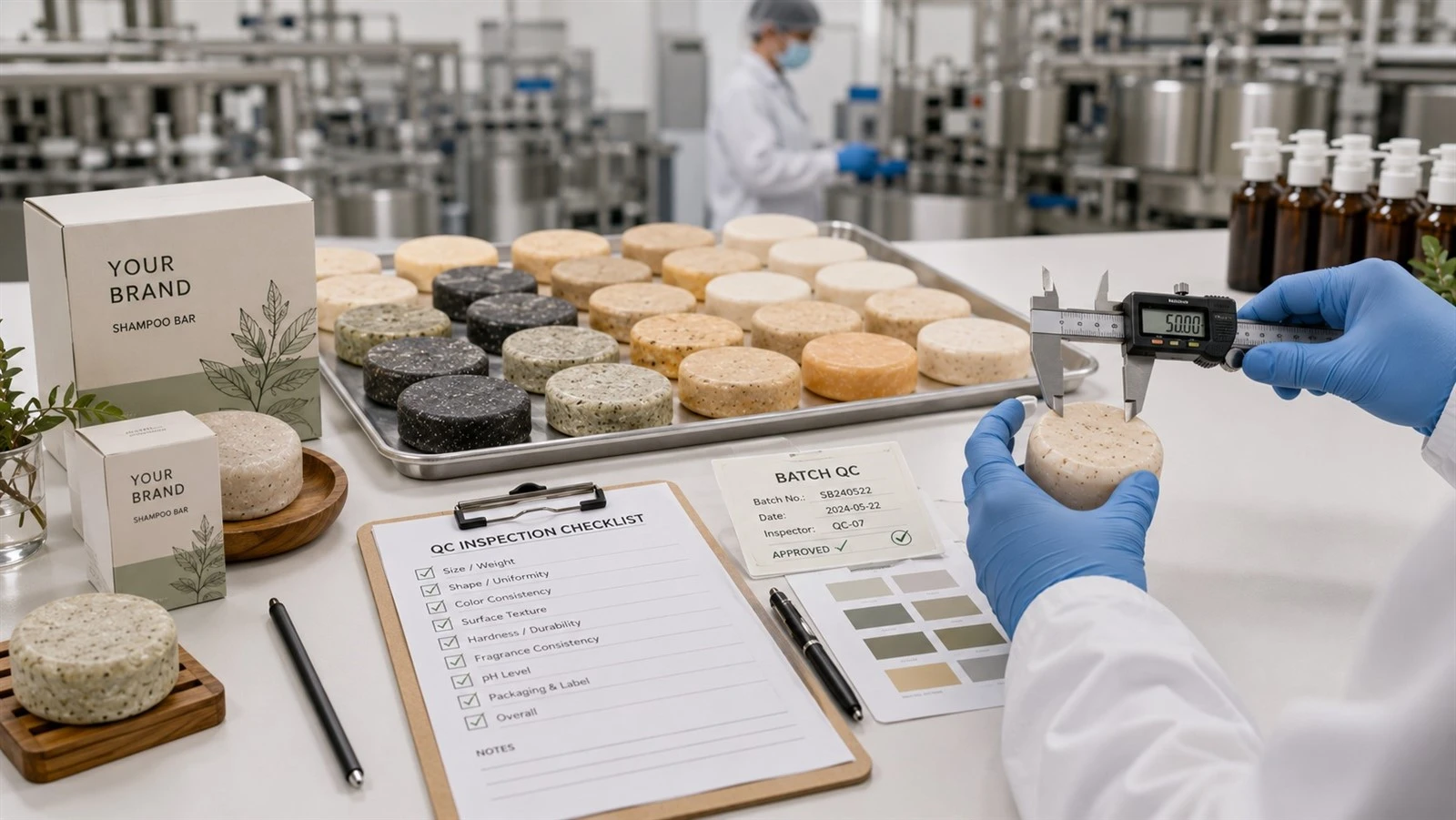
A reliable shampoo bar factory should have systems for raw material control, formula version control, weighing records, batch identification, in-process checks, finished-product inspection and retained samples. The factory should be able to trace a finished shampoo bar back to its production batch and key raw materials.
Batch consistency should be defined clearly. Weight, dimensions, fragrance, color, surface condition, hardness and packaging fit should have acceptable limits. Small variations may be reasonable for certain handmade-style products, but they should still be controlled.
This is especially important when shampoo bars must fit printed boxes, paper sleeves, tins or molded packaging. A small change in bar size or weight can affect packaging fit, insert stability and shipping safety.
Certificates can support supplier evaluation, but they should not be treated as the only proof of quality. Ask how the manufacturer applies its quality system in daily production. A certificate is useful only when the factory can also explain its actual controls, records and inspection methods.
Good quality discussions should cover raw material checks, formula version control, batch identification, retained samples, finished-product inspection, weight tolerance, dimension control and how quality issues are handled after shipment.
The goal is not only to approve one good sample. The goal is to ensure that the approved standard can be reproduced consistently.
Confirm Documentation and Market Support
A shampoo bar manufacturer does not replace the brand owner, importer, responsible person or regulatory consultant. However, the manufacturer should be able to provide technical documents that support market preparation.
The exact documentation depends on the destination market, formula, packaging and claims. Common documents may include a full INCI ingredient list, product specification, Certificate of Analysis, Safety Data Sheet where applicable, stability information, microbiological test data, packaging specifications, manufacturing records and relevant factory certificates.
For international private label shampoo bar projects, documentation should be discussed early. If artwork, claims, ingredients or product size change after packaging has been printed, delays and rework can occur.
A professional private label hair care manufacturer should understand which formula and production documents it can provide, which documents require third-party testing and which responsibilities remain with the brand owner or importer.
Be cautious if a supplier avoids documentation questions, provides incomplete ingredient information or promises that one certificate automatically guarantees approval in every market.
Final market requirements should always be confirmed by the brand owner, importer, responsible person or qualified local adviser before launch.
Evaluate Packaging and Export Experience
Packaging is part of the product, not a separate decoration. Shampoo bars can be affected by moisture, fragrance migration, color transfer, rubbing, chipping and compression during storage and shipping.
A capable shampoo bar manufacturer should review the bar size, weight tolerance, hardness and formula behavior before packaging production begins. Printing thousands of boxes before the final bar dimensions are approved creates unnecessary risk.
Packaging options may include paper boxes, kraft cartons, paper sleeves, wraps, paper tubes, tins, refill formats and gift boxes. The right choice depends on formula type, bar size, price positioning, sales channel and destination market.
For e-commerce and export orders, the unit package and master carton should be considered together. A strong retail box can still fail inside an oversized shipper if the bar moves during transport. Gift sets also need insert testing so products do not rub, chip or shift. Before approving bulk packaging, brands can review our private label shampoo bar packaging guide to compare plastic-free, retail-ready and export-safe options.
A wholesale shampoo bar supplier that can coordinate packaging sourcing may simplify the process, but the brand should still confirm material specifications, print quality, color tolerance, label layout, inner protection and final packing method.
Packaging should be confirmed after the bar size, formula behavior and sales channel are clear. If packaging is treated too late, the project may face printing delays, poor fit, higher shipping damage or rework before launch.
Compare MOQ, Pricing and Total Project Cost
The lowest unit price does not always create the lowest total project cost. A quote may look attractive but exclude important items such as sample development, formula revisions, custom molds, fragrance sourcing, packaging printing, label design, testing, assembly, export cartons or inspection.
MOQ should also be clarified carefully. Some suppliers calculate MOQ by formula. Others calculate it by fragrance, color, bar size, packaging design or printed carton quantity. A low product MOQ may still require a higher packaging MOQ.
Before comparing suppliers, ask what is included in the quoted price and what will be charged separately. Important cost items may include formula development, sample revisions, special ingredients, fragrance matching, custom molds, packaging dielines, printing plates, labels, gift box inserts, stability testing, microbiological testing, pre-shipment inspection and export cartons.
Trade terms also affect the real cost. EXW, FOB and CIF quotations cannot be compared as if they include the same services. Brands should understand which side is responsible for inland transport, export handling, freight, insurance, destination charges and customs-related work.
A higher quotation may provide better value if it includes stronger formulation support, more reliable packaging, clearer documentation and fewer production risks.
The correct comparison is not simply cost per bar. It is the total cost of bringing a stable, saleable and repeatable product to market.
Confirm Production Capacity, Lead Time and Reorder Support
A manufacturer may be suitable for a small first order but unable to support future growth. Before choosing a supplier, discuss both your initial launch quantity and possible reorder volume.
Ask how long production normally takes after formula, sample, packaging and artwork approval. Confirm whether the timeline includes packaging production, final assembly, inspection and export preparation.
Production capacity should not be evaluated only by a large monthly number. What matters is whether the factory can reserve capacity for your project, maintain quality during peak seasons and provide realistic delivery schedules.
A dependable shampoo bar OEM partner should communicate potential delays early rather than agreeing to an unrealistic deadline. Reliable forecasting is often more valuable than a fast promise that cannot be met.
Stable reorders are especially important for Amazon sellers, retailers and distributors, where out-of-stock problems can damage ranking, shelf space and customer trust.
Audit the Factory or Request a Live Factory Review
Factory photos, product images and certificates are useful, but they do not always show how production is controlled.
For larger projects, consider a physical visit, third-party audit or live video factory review. Look beyond the showroom. Review the raw material warehouse, weighing area, production equipment, drying or conditioning area, packaging line, finished goods storage and quality-control area.
Pay attention to whether materials are labeled, batches are separated, work areas are organized and production records are available. Ask to see retained samples, inspection procedures and examples of batch documentation.
The goal is not to find the most polished factory tour. The goal is to understand whether the manufacturer has repeatable systems behind its production.
If you cannot visit in person, a structured video call can still help. Ask the supplier to show the production flow, packaging area, sample room, QC process and warehouse conditions. A supplier that refuses reasonable transparency may not be the best choice for a long-term private label project.
Evaluate Communication and Project Management
Fast replies are useful, but accurate communication is more important.
A good shampoo bar supplier should explain limitations instead of agreeing to every request. Increasing oils may affect foam or hardness. A high fragrance level may influence stability or claim direction. A complex custom shape may increase breakage risk during demolding, packing or shipping. A very small box may not leave enough label space.
A supplier that discusses these trade-offs is often more reliable than one that says yes to every idea.
Communication should also be documented. Formula versions, fragrance codes, colors, bar dimensions, packaging materials, artwork files, approved samples, cost items and lead times should be confirmed in writing before mass production.
Scattered messages and verbal agreements can easily lead to mistakes. A professional OEM partner should help turn decisions into clear specifications.
Strong project management reduces misunderstanding, delays and production errors.
Use a Supplier Evaluation Scorecard
Before making the final decision, brands should compare manufacturers with a clear evaluation framework. This helps avoid choosing a supplier based only on price, one attractive sample or fast replies.
| Evaluation Area | What to Check | Red Flag |
|---|---|---|
| Formula capability | Soap-based, syndet, pH direction, foam, rinse feel, hair-type customization | One base formula is offered for every brand |
| Sample process | Revision rounds, repeated-use testing, feedback handling | Sample is approved after one visual check |
| Quality system | Batch records, traceability, weight and dimension control | Factory cannot explain QC limits |
| Documentation | INCI, COA, SDS, specifications, test support | Supplier avoids document questions |
| Packaging support | Box fit, label layout, gift set, export carton | Packaging is printed before final bar approval |
| MOQ and pricing | Formula MOQ, packaging MOQ, tooling, hidden fees | Quote is vague or incomplete |
| Capacity and lead time | Sample timeline, production slot, reorder support | Supplier promises unrealistic delivery |
| Communication | Written confirmations, risk warnings, version control | Supplier says yes to every request |
A strong supplier does not need to be perfect in every area, but it should be transparent about its capabilities, limitations and project requirements.
The best manufacturer is usually the one that can match your brand stage, product complexity, target market and launch timeline with the lowest overall project risk.
Is a China Shampoo Bar Manufacturer Right for Your Brand?
Working with a China shampoo bar manufacturer can be suitable for brands that need flexible OEM/ODM services, packaging resources, competitive production costs and the ability to develop multiple product types under one supplier system.
This can be useful for brands building a complete solid hair care range, such as shampoo bars, conditioner bars, soap bars, gift sets and other personal care products.
However, distance makes supplier evaluation more important. Brands need clear specifications, approved reference samples, written quality standards, packaging approval, document confirmation and agreed shipping terms.
A China shampoo bar supplier may be a good fit when your brand wants custom formula support, multiple shampoo bar varieties, packaging and label sourcing, solid hair care product line development, export packing support, cost-effective bulk production and OEM/ODM flexibility.
It may not be the right fit if your project requires extremely small handmade batches, immediate local delivery or market-specific regulatory handling that must be done entirely in your own country.
The key is not simply choosing China or local production. The key is choosing a manufacturer whose technical ability, documentation support, communication and production model fit your project.
Choose the Partner That Fits Your Brand Stage
There is no single best shampoo bar manufacturer for every brand. The right partner depends on your product stage, budget, sales channel and growth plan.
A startup may need a proven formula, flexible MOQ and clear sample process. A DTC brand may prioritize product differentiation, strong packaging and stable reorder support. An Amazon seller may need durable packaging, consistent quality and reliable documentation. A retail buyer may focus on capacity, barcode accuracy, case-pack planning and delivery reliability. A premium brand may require exclusive formula development, refined fragrance, unique sensory profile and distinctive packaging.
Before placing a bulk order, make sure the final formula, fragrance, color, size, weight, packaging, cost items, quality standards and production timeline are approved in writing. Keep an approved sample as the reference for mass production and confirm how pre-shipment inspection will be handled.
Choosing carefully at the beginning can reduce reformulation costs, packaging errors, launch delays, customer complaints and reorder problems later. For brands planning bundles or seasonal retail sets, a solid shampoo bar gift set can help increase perceived value and create a more complete offer.
Develop Your Private Label Shampoo Bar with Poleview
Poleview supports private label and custom shampoo bar projects with formula development, sample testing, fragrance and ingredient customization, bar shape options, logo embossing, packaging design and bulk manufacturing. If your brand is developing targeted shampoo bars for oily scalp, dry hair, color care or volumizing lines, explore our functional shampoo bar manufacturer page before requesting samples.
Whether your brand is launching one shampoo bar or building a complete solid hair care collection, our team can help evaluate formula direction, sample performance, packaging fit, documentation needs and production planning before commercial production.
Share your target market, formula direction, preferred bar format, packaging requirements and order plan with our team to receive suitable OEM options.
Discuss your private label shampoo bar project with Poleview.
Frequently Asked Questions
Q: 1. What should I ask a shampoo bar manufacturer before ordering?
A: Ask about soap-based and syndet formula capability, hair-type customization, sample revisions, testing, quality control, MOQ, packaging, lead time and documentation support. You should also confirm what is included in the quotation and what may require additional cost.
Q: 2. What is the typical MOQ for private label shampoo bars?
A: MOQ varies by factory, formula, fragrance, shape, packaging and customization level. Ready-made formulas may support lower quantities, while custom formulas, exclusive bar shapes or printed packaging may require higher minimums. Always confirm project-specific MOQ before approving samples or artwork.
Q: 3. Can a manufacturer develop a completely custom shampoo bar formula?
A: Yes. A custom shampoo bar manufacturer can develop a formula around hair type, cleansing level, surfactant system, fragrance, ingredients, bar hardness, pH direction and product positioning. Full custom development usually requires more time, testing and investment than selecting a ready-made formula.
Q: 4. How long does shampoo bar development take?
A: The timeline depends on formula complexity, sample revision rounds, testing requirements, packaging development and artwork approval. A ready-made private label project can move faster, while a full shampoo bar OEM project may require several rounds of testing before production approval.
Q: 5. How can I check the quality of bulk shampoo bars?
A: Compare bulk production with the approved reference sample. Check weight, dimensions, color, fragrance, surface condition, hardness, packaging fit and carton condition. For larger orders, consider pre-shipment inspection using agreed sampling standards and acceptance limits.
Q: 6. What documents should a shampoo bar supplier provide?
A: Common documents may include a full INCI list, product specification, Certificate of Analysis, relevant safety information, stability or microbiological test data, packaging specifications and manufacturing records. Exact requirements depend on the destination market and should be confirmed by the brand owner, importer or local adviser.
Editorial Note
Cosmetic documentation, labeling and market-entry requirements vary by country and may change over time. The manufacturer can provide technical support and production documents, but final compliance should be reviewed by the brand owner, importer, responsible person or qualified local adviser before launch.
Related Shampoo Bar Guides & Product Pages
Private Label Shampoo Bar Guide: Formulas, Packaging, Manufacturing and Brand Development
Soap-Based vs Syndet Shampoo Bars: Which Formula Is Better for Private Label Brands?
Private Label Shampoo Bar Packaging Guide: Plastic-Free, Retail-Ready and Export-Safe Options
Functional Shampoo Bar Manufacturer for Private Label Hair Care Brands