

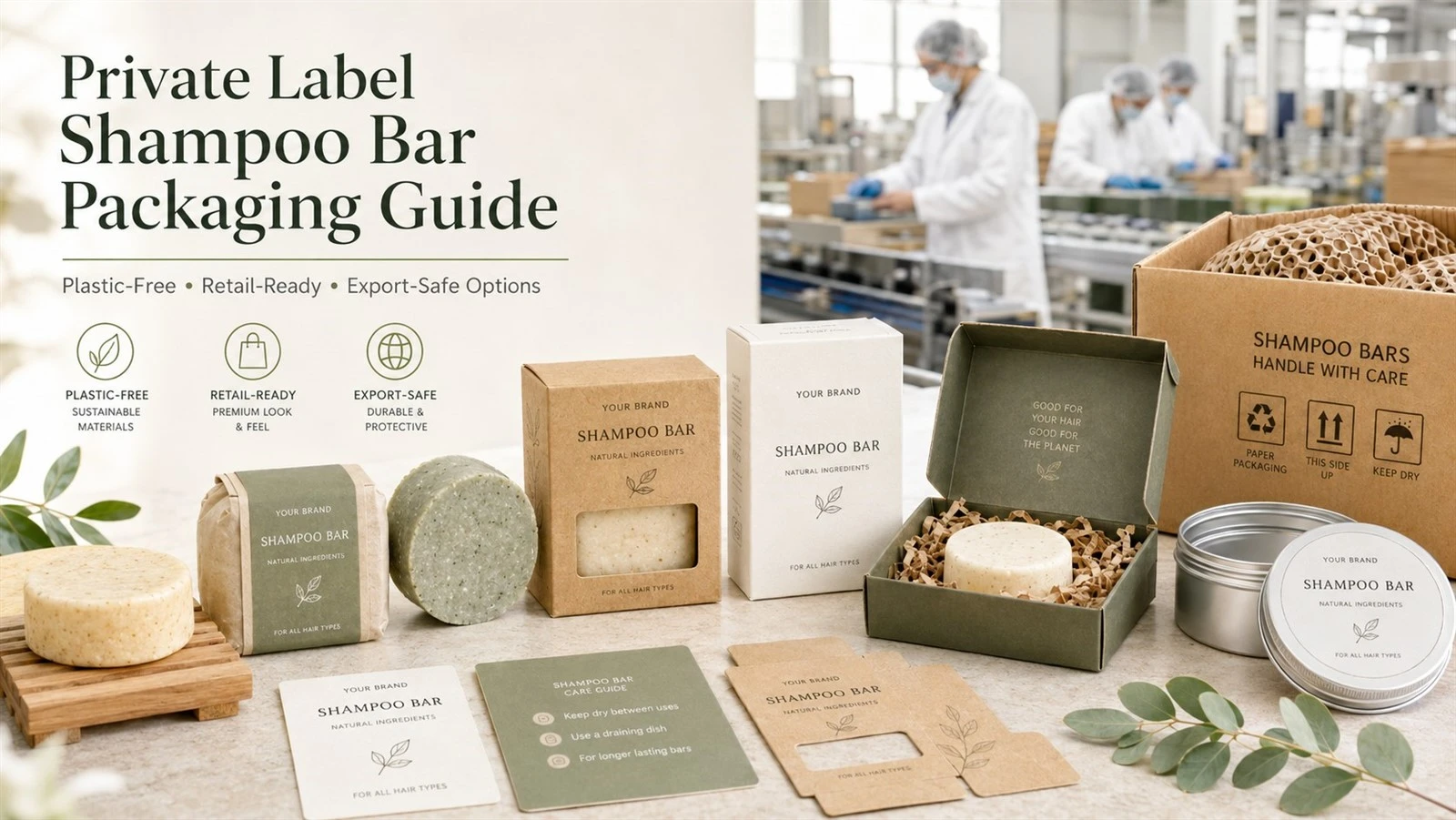
A shampoo bar may look simple, compact and easy to pack, but its packaging is not a final decoration step. For private label brands, shampoo bar packaging affects product protection, shelf presentation, label compliance, customer education, export safety and repeat purchase experience.
A good package should do more than look eco-friendly. It should fit the actual bar size, protect the formula, preserve fragrance, reduce scuffing, provide enough label space and arrive in saleable condition after shipping. This is especially important for brands selling through Amazon, retail stores, salons, subscription boxes, travel channels or international distributors.
For OEM shampoo bar projects, packaging should be developed together with the formula and bar format. For a broader overview of formula selection, SKU planning, packaging and OEM production, read our private label shampoo bar guide before starting your project. A softer syndet shampoo bar, a highly fragranced bar, a colorful bar or a gift set may all require different packaging decisions. A box that works well for one product may not protect another.
This guide explains how private label brands can compare plastic-free shampoo bar packaging, retail-ready boxes, reusable tins, paper sleeves, gift sets and export-safe packing options before moving into bulk production.
Why Shampoo Bar Packaging Is Part of Product Development
Many brands start packaging discussions by asking for a box design or a dieline. In reality, the better starting point is the product itself.
A shampoo bar is a solid product, but it can still be affected by moisture, fragrance loss, oil transfer, color transfer, chipped corners, surface scuffing and storage conditions. Packaging has to protect the bar while also communicating the brand story quickly.
This is why private label shampoo bar packaging should be treated as a product development decision, not a box selected after the formula is finished.
The formula, bar size, target channel and packaging structure should work together. A firm soap-based bar may work with a paper sleeve or folding carton. A softer syndet bar may need a closed box with better fit. A premium shampoo and conditioner bar set may require a gift box with paper inserts. An Amazon unit may need stronger edge protection than a salon product shipped in controlled case packs.
Good packaging answers three questions:
First, does it protect the bar?
Second, does it help the customer understand the product?
Third, can it survive the real sales and shipping route?
If the answer to any of these is weak, the packaging is not ready for production.
Start with the Formula, Channel and Packaging Brief
Before choosing custom shampoo bar packaging, brands should prepare a clear packaging brief. This brief does not need to be complicated, but it should include the practical details that affect structure, material and cost.
The most important inputs include bar weight, dimensions, formula type, bar hardness, fragrance level, color system, logo embossing, target market, sales channel, sustainability claim, label requirements, order quantity and target price range.
If your team is still choosing between a traditional soap-based bar and a modern syndet bar, review our soap-based vs syndet shampoo bars guide before finalizing the packaging structure.
Formula behavior matters. A bar that is too soft, too oily or unstable in humidity cannot be fixed by a beautiful box. The manufacturer should first confirm product hardness, dimensional tolerance and basic storage behavior before finalizing the package.
Sales channel also changes the packaging risk. Boutique retail packaging needs shelf appeal and tactile quality. E-commerce packaging needs edge protection and parcel resistance. Chain retail may require barcode placement, case-pack planning and consistent carton specifications. Gift sets need inserts that hold each product in place.
A useful packaging brief should answer:
What is the bar like?
Where will it be sold?
What must the package prove: plastic-free, recyclable, premium, low-cost, travel-ready, export-safe or giftable?
When the packaging brief is clear, the OEM supplier can recommend a realistic structure instead of copying a competitor's package.
Main Packaging Formats for Private Label Shampoo Bars
There is no single best package for every shampoo bar. The best option depends on formula behavior, brand positioning, sales channel, budget and shipping route.
Folding cartons and kraft paper boxes are usually the most versatile options for private label shampoo bars. They provide branding space, protect corners and work well for retail, Amazon and export units. White board gives cleaner color reproduction, while kraft paper creates a more natural look. For export, a closed carton is usually safer than a windowed box.
Paper sleeves, wraps and belly bands use less material and fit minimalist, artisan or refill-style ranges. Their weakness is limited protection and reduced label space. They may work for firm bars, but they are not always suitable for softer or more fragrant formulas.
Paper tubes create a premium silhouette and strong product protection. They can work well for specialty retail, travel ranges and higher-value single bars. However, they use more material and create more freight volume than flat-packed cartons.
Aluminum tins are durable and reusable, which makes them attractive for travel or refill concepts. But tins cost more, add weight and may trap moisture if consumers store wet bars inside them after use.
Gift boxes are useful for shampoo and conditioner bar sets, holiday collections and premium bundles. The insert design matters as much as the outer box. Products should not move, chip or rub during transport.

| Packaging Format | Best For | Main Advantage | Main Risk |
|---|---|---|---|
| Folding carton / kraft box | Retail, Amazon, export orders | Good label space and corner protection | Oil staining, weak board or poor fit |
| Paper sleeve / belly band | Minimalist, refill or artisan ranges | Less material and strong eco-positioning | Limited protection and label space |
| Paper wrap + carton | Bars sensitive to scuffing or transfer | Better surface protection | May become unnecessary double packaging |
| Paper tube | Premium singles and specialty retail | Strong protection and high-end look | Higher material use and freight volume |
| Aluminum tin | Travel and reusable concepts | Durable and reusable | Cost, weight and wet-bar storage risk |
| Gift box with paper insert | Sets and seasonal collections | Strong presentation and product separation | Insert fit and assembly cost |
The goal is not to choose the most elaborate package. The goal is to choose the structure that fits the formula, supports the selling price and can be repeated consistently in production. For brands planning shampoo and conditioner bar bundles, a solid shampoo bar gift set can increase perceived value and create a more complete retail offer.
How to Make Plastic-Free Packaging Claims More Reliable
Plastic-free shampoo bar packaging is attractive to many consumers, but the claim must be checked carefully. A kraft paper appearance does not automatically mean the package is plastic-free or recyclable.

Brands should verify every component of the packaging structure, including paperboard, window material, coating, lamination, adhesive, ink, label stock, inner wrap and sealing method. A kraft carton with a PET window is not plastic-free. A paper-looking wrap may still contain polymer coating. A compostable film may require special composting conditions that are not available to every consumer.
The same discipline applies to broader eco-friendly claims. "Eco-friendly" should be defined more clearly. Does the brand mean reduced material, recycled content, certified fiber, no plastic components, recyclability, reusability or compostability? Brands comparing solid formats with bottled hair care can also read our shampoo bar vs liquid shampoo guide to understand why packaging reduction is part of the solid hair care story.
One package rarely maximizes every sustainability attribute. A thinner sleeve may use less material, but it may not protect the bar during export. A reusable tin may reduce single-use packaging, but it adds weight and cost. A closed paper box may not look as minimal as a sleeve, but it may provide better protection and more label space.
The practical approach is to start with the lightest structure that can protect the product, then add protection only where testing shows a real need.
Evidence-based packaging is more credible than adding a bag, shrink film and box to every shampoo bar.
Build Retail-Ready Packaging for Different Sales Channels
Retail-ready shampoo bar packaging should communicate quickly. Within a few seconds, the customer should understand the brand, product type, main hair benefit and key differentiator.
The front panel should not carry too many messages. Brand name, product name, hair type, fragrance, bar weight and one or two key benefits are usually enough for the first view. Secondary storytelling can move to the side panel, back panel, insert card or QR-linked page.
For a multi-SKU shampoo bar range, color coding can help customers navigate the line. For example, oily scalp, dry hair, curly hair and color-care bars can use different visual systems while keeping the same brand structure.
Label space is also a practical issue. A shampoo bar package may need product identity, net content, directions, ingredient list, warning or storage advice, batch or durability information, company details, barcode and country-specific information. Global launches may require translations or regional artwork versions.
Shrinking the text to fit a small box is not a good solution. A custom OEM supplier can adjust panel size, create regional artwork, use a peel-back label, simplify the front panel or move non-essential storytelling to an insert.
| Sales Channel | Packaging Direction | What to Check |
|---|---|---|
| Boutique retail / salon | Printed carton or premium sleeve | Shelf story, finish, barcode position |
| Amazon / e-commerce | Closed carton with fitted mailer | Edge protection and parcel handling |
| Chain retail | Consistent carton and case-pack plan | Barcode reliability and replenishment specs |
| Travel / refill line | Tin, compact carton or sleeve | Wet-bar storage and refill logic |
| Gift set | Gift box with paper insert | Product separation and insert fit |
| Multi-country launch | Carton with regional artwork versions | Readable legal copy and translations |
Retail-ready packaging is not just attractive design. It is the point where branding, legal copy, product education and logistics must all fit into one structure. Poleview supports private label shampoo bar manufacturing with custom formula, bar shape, logo embossing, packaging design and bulk production support.
Design Packaging for Export, Humidity and Parcel Handling
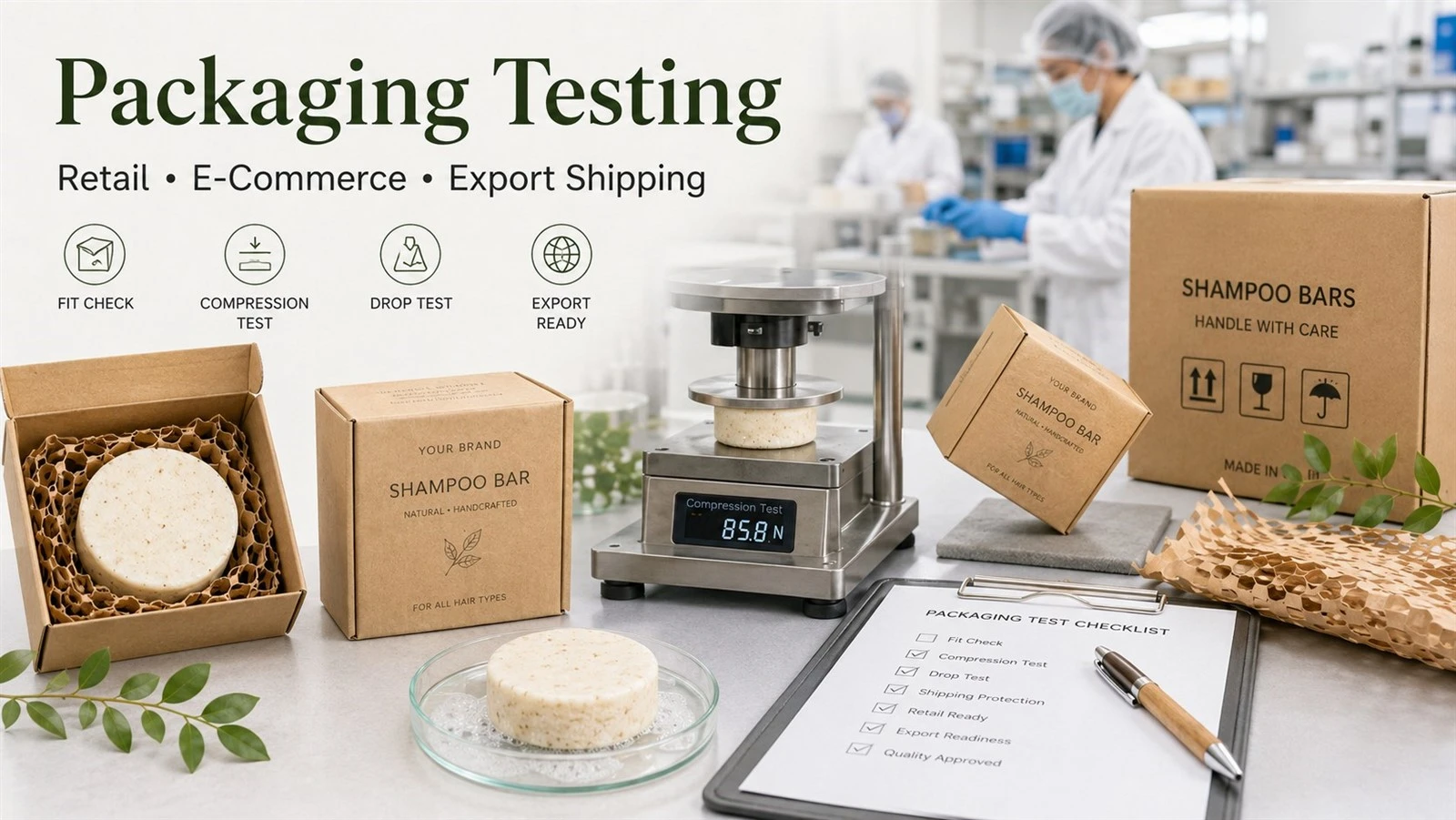
Export-safe shampoo bar packaging should be tested with the actual formula, actual bar size and actual packaging structure.
This matters because fragrance level, color system, oils, powders, conditioning ingredients and bar hardness may affect staining, sticking, fragrance retention and dimensional stability. Humidity is also important for syndet bars and other formulas that may absorb moisture.
A retail box may look strong by itself but still fail inside an oversized shipper. The unit box and master carton should be designed as one system. Correctly sized cases, dividers, paper pads or inserts can reduce movement, stacking pressure and abrasion.
For parcel shipments, brands should consider drop, vibration and compression risks. Formal certification is not always required for every project, but practical transport checks can reveal crushed corners, loose inserts, scuffed finishes, bar movement or gift set damage before shipment. For broader project support, Poleview also provides private label personal care manufacturing across solid care, hair care, body care and bath products.
Acceptance criteria should reflect retail appearance. It is not enough that the product remains intact. It should arrive in a condition that the retailer, distributor or end customer can accept.
Export-safe packaging should check:
bar movement inside the box, edge damage, surface scuffing, fragrance loss, color transfer, box deformation, barcode readability, insert fit and master carton strength.
For hot and humid markets, storage testing should also review sweating, softening, sticking and fragrance changes before the brand approves bulk packaging.
Choose the Right Level of Custom Shampoo Bar Packaging
Not every brand needs fully custom packaging from the first order. The right level of customization depends on launch stage, budget, order quantity, lead time and brand positioning.
Ready-to-market packaging uses an existing structure, such as a proven box size, with customized artwork, labels or sleeves. This is often suitable for smaller launches, market testing or brands that want to move quickly.
Semi-custom packaging adjusts material, finish, insert, color system or label layout while keeping a reliable structure. This can be a good balance for brands that need differentiation but do not want the cost or lead time of a new structural dieline.
Full custom shampoo bar packaging may include exclusive bar shape, logo embossing, custom dimensions, new dieline, gift set structure, insert design and coordinated master carton. This option is better for premium brands, retail programs or long-term product lines.
As customization increases, buyers should clarify tooling, printing minimums, material lead time, artwork revisions, color approval and sample rounds. A packaging idea is not ready for production until the specification records material, dimensions, tolerance, finish, printing method, glue position, insert fit and approved color reference.
Custom packaging should turn a brand concept into a repeatable manufacturing standard.
A Practical Packaging Approval Process Before Bulk Production
Packaging should move in parallel with formula development, but each approval gate must be clear.
A practical approval process usually follows this path:
Formula and bar format approval → sales channel and claim direction → packaging structure shortlist → material compatibility and fit test → artwork, barcode and label review → pre-production sample approval → master carton specification
The formula and bar size should be confirmed before final artwork is printed. If ingredients, net weight or dimensions change later, the packaging may become obsolete.
Material compatibility should also be checked before bulk printing. The team should review whether the bar stains the board, transfers color, loses fragrance, sticks to the inner wrap or moves inside the box.
Artwork should be reviewed for readability, barcode placement, ingredient list, directions, claims, translations and destination-market requirements. The brand owner, importer or local responsible party should review final artwork before printing.
A signed pre-production sample should represent the final structure, material, color, finish, fit and packing method. Master carton specifications should also be approved, especially for export or e-commerce projects.
Rushed packaging approval is one of the most common causes of avoidable delays in private label shampoo bar projects.
Common Shampoo Bar Packaging Mistakes
One common mistake is choosing packaging only from a photo. A box may look beautiful in a mockup but fail when tested with the actual bar.
Another mistake is assuming kraft appearance proves sustainability. Kraft color is a visual style, not a complete environmental claim. Coating, lamination, adhesive, label stock and window material still need to be checked.
Some brands underestimate label space. Shampoo bar packaging may need more room than expected for ingredients, directions, weight, warnings, barcode, company information and translations.
Oversized packaging is another issue. A larger box may look premium, but it can increase freight cost, create more empty space and weaken the brand's sustainability story.
Gift set packaging can fail when inserts are approved without production-tolerance samples. A loose insert can allow products to move, chip or rub during shipping.
Another mistake is testing only the retail box and ignoring the final shipper. The outer carton, dividers and packing method may determine whether the product arrives in saleable condition.
Finally, some brands print too early. If the formula, claims, bar weight or ingredient list changes after printing, packaging may need to be reworked or discarded.
A capable OEM supplier should challenge these risks early. The goal is not the cheapest package or the most decorative package. The goal is a practical, repeatable and saleable package.
Develop Custom Shampoo Bar Packaging with Poleview
Poleview supports private label and OEM/ODM shampoo bar projects with formula development, bar shape customization, logo embossing, fragrance selection, label layout and packaging development.
For packaging projects, our team can help brands compare folding cartons, kraft boxes, paper sleeves, wraps, tubes, tins, gift boxes and export cartons based on formula behavior, sales channel and target market.
The practical advantage of working with an integrated OEM supplier is that the bar and packaging can be tested together before bulk production. This helps reduce problems such as poor fit, surface scuffing, staining, fragrance loss, crushed corners or gift set movement.
Whether your brand needs plastic-free shampoo bar packaging, retail-ready cartons, Amazon-friendly packing or gift set packaging, Poleview can help align the formula, bar size, artwork, packaging structure and master carton before mass production.
Share your target market, sales channel, bar size, preferred packaging format, sustainability direction and order plan with our team. If your brand is developing functional shampoo bars for oily scalp, dry hair, color care or volumizing lines, packaging should be planned together with formula performance and SKU positioning.
Discuss your private label shampoo bar packaging project with Poleview.
Get a Custom Shampoo Bar Quote
Frequently Asked Questions
Q: 1. What is the best packaging for a private label shampoo bar?
A: For many retail and export projects, a folding carton or kraft paper box is a balanced starting point. It provides label space, corner protection and strong plastic-free potential when the structure is unlaminated and window-free. The final choice should still be tested with the actual formula.
Q: 2. Is kraft paper shampoo bar packaging always plastic-free?
A: No. Kraft appearance does not guarantee plastic-free packaging. Coating, lamination, adhesive, window material, label stock and inner wrap should all be checked before making a plastic-free or recyclable claim.
Q: 3. Does every shampoo bar need an inner wrap?
A: No. An inner wrap should be used only when testing shows a real need for oil control, fragrance retention, color-transfer reduction, scuff protection or moisture management. Unnecessary wrapping may weaken a plastic-free positioning.
Q: 4. What packaging works best for shampoo bar gift sets?
A: Gift sets usually need a folding or rigid box with a fitted paperboard or molded pulp insert. The insert should keep shampoo bars, conditioner bars or accessories separated during storage and shipping.
Q: 5. How should export-safe shampoo bar packaging be tested?
A: Brands should test the actual bar, unit package, insert, master carton and packing method together. Testing should check movement, chipped edges, scuffing, box deformation, humidity effects and barcode readability after transport-style handling.
Q: 6. Can a private label manufacturer support custom shampoo bar packaging?
A: Yes. A private label shampoo bar manufacturer can usually support packaging structure selection, label layout, box artwork, gift set options, sample review and export packing. The level of customization depends on formula, packaging type, order quantity and project timeline.
Editorial Note
Packaging, cosmetic labeling and environmental-claim requirements vary by market and may change over time. Final artwork and claims should be reviewed by the brand owner, importer, responsible person or qualified local adviser before bulk printing.
Related Shampoo Bar Guides & Product Pages
Private Label Shampoo Bar Guide: Formulas, Packaging, Manufacturing and Brand Development
Soap-Based vs Syndet Shampoo Bars: Which Formula Is Better for Private Label Brands?
Functional Shampoo Bar Manufacturer for Private Label Hair Care Brands