

Two shampoo bars can look almost identical on the shelf. They may have the same shape, similar colors and even a similar fragrance direction. But once customers start using them, the difference can be obvious.
The main reason is the formula system. For a broader overview of formula selection, packaging, sampling and brand development, read our private label shampoo bar guide.
For private label shampoo bar development, one of the first decisions is whether the product should be a soap-based shampoo bar or a syndet shampoo bar. This choice affects pH, foam quality, cleansing strength, rinse feel, hard-water performance, bar durability, cost, market positioning and customer satisfaction.
For brands planning a new solid hair care line, Poleview provides private label shampoo bar manufacturing with custom formula, fragrance, shape, logo embossing and packaging support.
For most modern private label hair care brands, a syndet shampoo bar is usually the more flexible choice. It gives the formulator better control over pH, mildness, foam, conditioning feel and hair-type-specific performance.
That does not mean soap-based shampoo bars have no place. They can still work well for brands built around handmade identity, traditional soap-making, rustic packaging or a simple botanical story.
The better question is not "Which formula is better for everyone?"
The better question is:
Which formula fits your brand promise, target customer and sales channel?
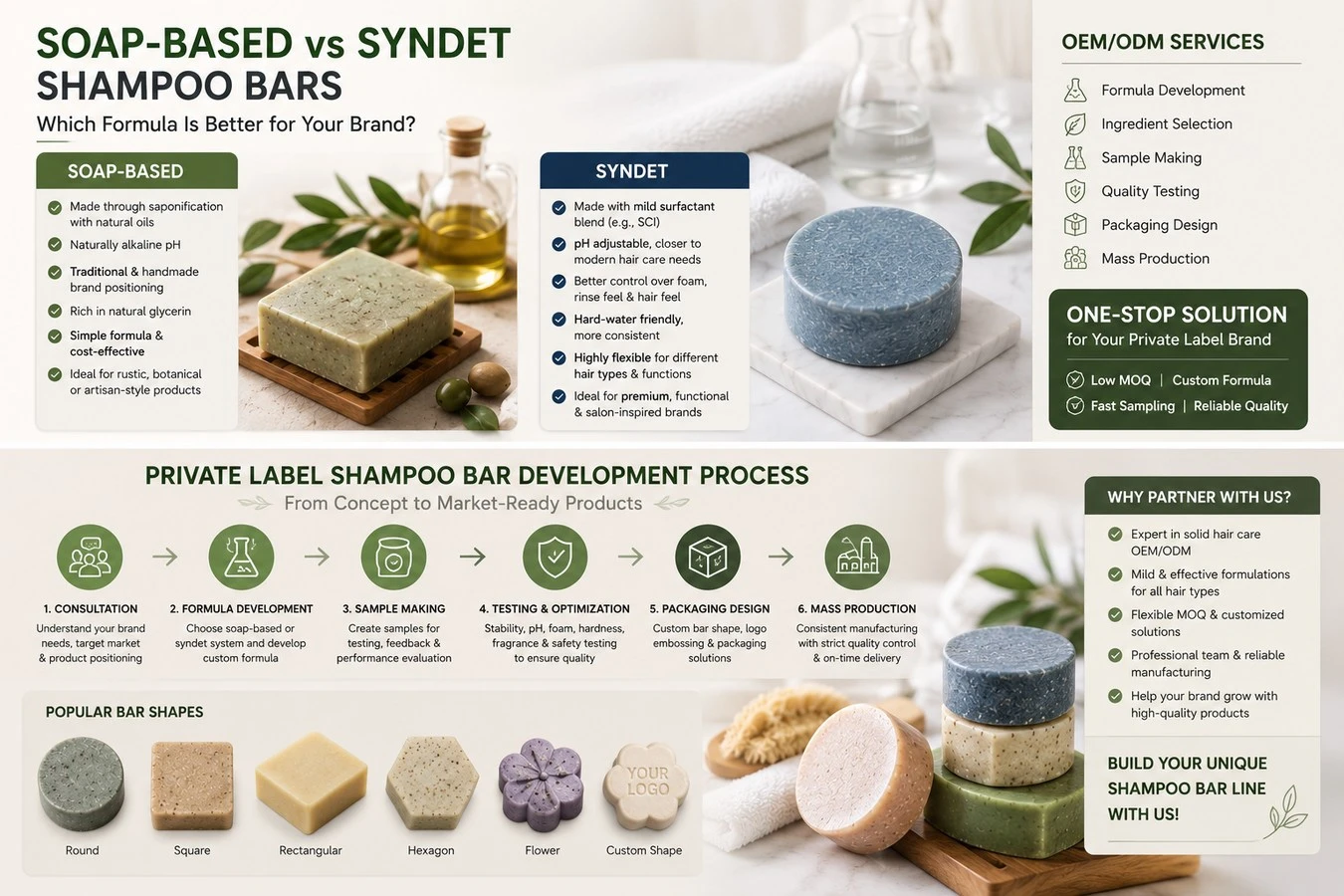
Quick Answer: Which Formula Should Your Brand Choose?
A soap-based shampoo bar is usually selected for story, appearance and traditional positioning. A syndet shampoo bar is usually selected for performance, formula control and modern hair care expectations.
| Brand Goal | Better Formula Direction | Why It Works |
|---|---|---|
| Handmade or artisan brand story | Soap-based shampoo bar | Strong traditional and natural-style identity |
| Modern solid hair care line | Syndet shampoo bar | Better control over pH, foam and rinse feel |
| Oily scalp positioning | Syndet shampoo bar | Cleansing strength can be adjusted more precisely |
| Dry, damaged or curly hair | Syndet shampoo bar | Easier to build a smoother, more conditioning after-feel |
| Color-treated hair | Syndet shampoo bar | Easier to design a milder, lower-stripping formula |
| Rustic gift product | Soap-based shampoo bar | Good visual appeal and simpler ingredient story |
| Premium functional shampoo bar | Syndet shampoo bar | Better fit for targeted hair care positioning |
| Botanical handmade collection | Soap-based shampoo bar | Strong visual and ingredient storytelling |
For most private label brands targeting repeat purchase in hair care, syndet is usually the safer technical route. For brands where the handmade story matters more than a salon-like wash experience, soap-based formulas may still be suitable.
What Is a Soap-Based Shampoo Bar?
A soap-based shampoo bar is made through saponification. Oils or fats react with an alkaline ingredient, usually sodium hydroxide, to create soap.
The formula may include oils such as coconut oil, olive oil, castor oil, sunflower oil, palm oil, shea butter or other plant-based oils. Brands may also add clays, botanical powders, essential oils, fragrance, plant extracts or decorative ingredients to create a more distinctive appearance.
From a branding point of view, soap-based shampoo bars are easy to understand. They support a traditional, handmade, botanical or minimalist product story. For brands already selling handmade soap, natural body care or rustic gift products, this formula direction can feel consistent with the rest of the range. Brands that focus on a traditional soap-making story may also explore Poleview's private label handmade soap manufacturing capabilities.
Soap-based bars are also visually flexible. They can be made with swirls, layers, natural colors, speckles, embossed logos and custom shapes. In many projects, the cost can also be more friendly than a complex syndet formula.
The main limitation is pH.
True soap is naturally alkaline. Hair and scalp products, especially modern shampoo formulas, are usually expected to feel closer to a mildly acidic range. When a shampoo bar is too alkaline for the user's hair type, the hair may feel rough, dry, tangled or harder to comb.
This can be more noticeable on bleached, colored, curly, porous, long or chemically treated hair. These hair types usually need better control over cleansing strength and after-wash feel.
Hard water can also create problems. Minerals in hard water may react with soap and form deposits, which can reduce foam or leave a coated feeling on the hair.
Because of this chemistry, a true soap-based shampoo bar cannot easily become a pH-balanced shampoo bar. Reducing the pH too far may affect the soap structure itself. Brands that need a mildly acidic formula usually need to consider a syndet system.
For brands that need targeted performance positioning, our functional shampoo bar manufacturer page shows formula directions for scalp care, oil control, repair, moisture and color care.
What Is a Syndet Shampoo Bar?
"Syndet" means synthetic detergent. In cosmetics, it refers to a cleansing product made with surfactants instead of traditional soap.
The word "synthetic" can sound negative in consumer marketing, but a syndet formula is not automatically harsh. Many modern syndet shampoo bars are designed to be milder, more stable and more predictable than traditional soap-based bars.
Common surfactants used in syndet shampoo bars may include Sodium Cocoyl Isethionate, Sodium Lauroyl Methyl Isethionate, Sodium Methyl Cocoyl Taurate, Sodium Cocoyl Glutamate and other mild surfactant blends.
An SCI shampoo bar, based on Sodium Cocoyl Isethionate, is one of the most common examples. SCI is widely used because it can create a creamy foam and a smoother cleansing experience compared with traditional soap.
A syndet system gives the manufacturer more control over the final product experience. The formula can be adjusted by pH, foam speed, foam density, rinse feel, hardness, wear rate, moisture resistance and conditioning after-feel.
This makes syndet formulas especially useful for private label brands developing products for oily scalp, dry hair, fine hair, curly hair, color-treated hair or frequent washing.
Syndet shampoo bars also tend to perform more consistently in hard water because surfactants do not react with minerals in the same way true soap does. In some formulas, chelating ingredients may still be added to improve performance in mineral-rich water.
The trade-off is complexity. A syndet shampoo bar usually requires more technical development. The formula has to balance cleansing power, foam, hardness, wear rate, storage stability and hair feel. It may also cost more, especially when the formula uses premium surfactants, conditioning agents, proteins, panthenol, botanical extracts or functional ingredients.
Soap-Based vs Syndet Shampoo Bar: Main Differences
The difference between a soap-based shampoo bar and a syndet shampoo bar is not just about whether the ingredients sound natural or synthetic. It is about how the product performs and how it fits the brand's positioning.
| Factor | Soap-Based Shampoo Bar | Syndet Shampoo Bar |
|---|---|---|
| Cleansing System | Saponified oils | Cosmetic surfactant blend |
| Typical pH | Naturally alkaline | Adjustable, often closer to modern hair care needs |
| Hair Feel | May feel rough, dry or coated on some hair types | Can be designed for smoother after-feel |
| Foam | Can foam well, but may vary in hard water | More controllable foam quality |
| Hard-Water Performance | More likely to form deposits | Usually more consistent |
| Formula Flexibility | More limited | Highly flexible |
| Hair-Type Targeting | Harder to fine-tune | Easier to customize by hair type |
| Best Positioning | Handmade, traditional, rustic, natural-style | Functional, modern, salon-inspired, premium |
| Customization Strength | Appearance and ingredient story | Performance and hair feel |
| Typical Cost | Often lower | Usually medium to premium |
This does not mean every soap-based bar performs poorly, or every syndet bar is automatically mild. The final result still depends on the full formula, ingredient percentages, processing method, fragrance level, bar structure and intended user.
For private label brands, the key is to match the formula system with the product promise. If your team is also comparing product formats, our guide to shampoo bar vs liquid shampoo explains why solid shampoo formats are becoming attractive for OEM/ODM hair care brands.
Which Formula Is Better for Most Private Label Brands?
For most mainstream private label hair care brands, a syndet shampoo bar is usually the more practical choice. If your brand is ready to compare formula options, Poleview can support custom shampoo bar formulation from sample testing to bulk production.
The reason is control.
Modern consumers often compare shampoo bars with liquid shampoo. They expect the bar to foam easily, rinse cleanly, last for a reasonable number of washes and leave the hair manageable. They also expect different products to match different hair needs.
A syndet base makes these expectations easier to meet. It can be adjusted for stronger cleansing, milder cleansing, richer foam, lighter rinse feel or a more conditioning finish.
It also supports clearer product positioning. A brand can develop a volumizing shampoo bar for fine hair, a moisturizing shampoo bar for dry hair, a scalp balance shampoo bar for oily roots, or a color care shampoo bar for dyed or bleached hair.
This flexibility matters when a brand wants to build a full solid hair care line instead of only one SKU. The same general technology can be adapted into different products while keeping the brand identity consistent.
Soap-based formulas still have a role. They may be suitable for brands focused on traditional cold-process production, handmade appearance, rustic packaging or simple ingredient communication.
The most important point is customer expectation. A consumer buying a handmade botanical bar may accept a different washing experience from someone buying a premium salon-style shampoo bar.
Choosing by Hair Type and Market Positioning
A common mistake is trying to create one shampoo bar for every customer. In practice, oily scalp, dry hair, curly hair, fine hair and color-treated hair need different cleansing and conditioning directions.
For brands targeting oily scalp, a syndet shampoo bar is usually easier to adjust. The cleansing level can be made stronger or lighter depending on the market, and the rinse feel can be designed to feel fresh without leaving the hair overly dry.
For dry hair or curly hair, syndet systems are usually more suitable because they allow better control over conditioning feel. The formula can include milder surfactants, conditioning agents, proteins, panthenol or emollients to improve smoothness and manageability.
For color-treated or bleached hair, a mildly acidic syndet direction is generally easier to optimize. These hair types often need a gentler cleansing profile and a smoother after-wash feel.
For fine or flat hair, a syndet bar can be developed with a lighter after-feel, stronger foam and less heavy oil content. This makes it easier to position the product around volume or fresh daily cleansing.
For handmade botanical brands, a soap-based shampoo bar may still make sense. The formula can support a traditional story, rustic appearance, botanical colors and simple ingredient communication. This direction is especially suitable when the brand's customer values craft identity more than a modern salon-like wash feel.
For premium functional hair care, syndet is usually the stronger route. It offers more room for formula adjustment, hair-type-specific positioning and repeat-purchase experience.
This does not mean the choice is fixed for every brand. A soap-based bar can work well for the right audience. A syndet bar can also feel too strong if it is poorly balanced.
The practical question for brand owners is simple:
Who will use this shampoo bar, and what should their hair feel like after washing?
Once that answer is clear, the formula direction becomes much easier to define. Brands planning a broader solid hair care product line can develop shampoo bars, conditioner bars and related solid hair care products under one collection.
Is a Sulfate-Free Shampoo Bar Always Mild?
Sulfate-free has become an important claim in hair care, but it should not be treated as a complete formula strategy.
A sulfate-free shampoo bar does not contain common sulfate surfactants. However, the remaining surfactants may still be used at a strong cleansing level. A sulfate-free product can still feel too dry for damaged, curly or color-treated hair if the complete formula is not balanced.
Mildness depends on several factors: surfactant type, surfactant percentage, pH, fragrance level, conditioning ingredients, oils, emollients and how often the product is used.
A well-designed mild surfactant shampoo bar may combine a primary cleanser with secondary surfactants that improve foam and reduce harshness. Conditioning polymers, panthenol, proteins, botanical oils or emollients may also be added to improve hair feel.
But more ingredients do not automatically make a better product. Some oils can reduce foam. Too much butter can make the bar feel heavy. Too many powders can affect rinse-off. A formula with a long ingredient list can still perform poorly if the system is not balanced.
For private label brands, sulfate-free can be a useful claim, but it should be supported by a thoughtful formula structure.
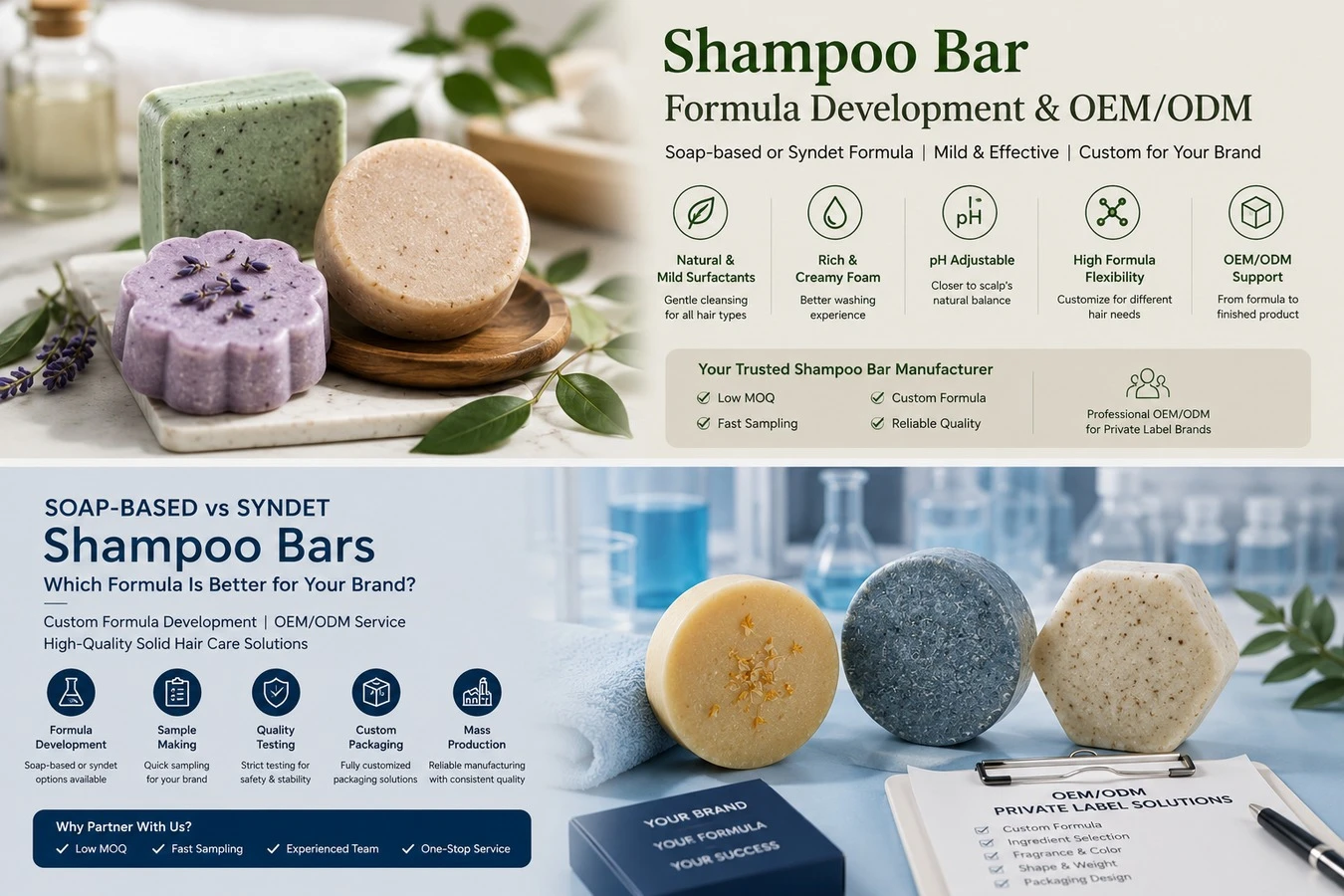
What Should Brands Confirm Before Formula Development?
A clear development brief helps the OEM manufacturer create better samples and reduces unnecessary revisions.
Before starting custom shampoo bar formulation, brand owners should confirm the target user, brand positioning, formula direction, cleansing level, foam expectation, ingredient restrictions, bar design, packaging format and target price range.
A vague request such as "we want a natural shampoo bar" is difficult to develop accurately. It does not tell the manufacturer whether the product should be soap-based or syndet, whether it is for oily scalp or dry hair, whether the bar should be rich and creamy or light and fresh, or whether the packaging should support a premium retail line or a lower-cost gift set.
A stronger brief would be more specific:
A sulfate-free syndet shampoo bar for oily scalp, with strong foam, fresh herbal fragrance, firm bar hardness and recyclable paper box packaging.
This type of brief gives the manufacturer a clear starting point. It also makes sample evaluation easier because both sides know what the formula is supposed to achieve.
Brand owners should also confirm any ingredient restrictions early. Requirements such as vegan, silicone-free, palm-oil-free, fragrance-free, essential-oil-free or colorant-free may affect the formula structure, cost, processing method and testing plan.
Bar size and shape also matter. A small travel-size bar, a standard retail bar and a detailed custom-molded bar may need different hardness and processing conditions. Packaging should be discussed at the same time because shampoo bars can be affected by moisture, friction and storage environment.
After choosing the formula system, brands should also confirm the packaging structure. Our private label shampoo bar packaging guide explains how to compare plastic-free, retail-ready and export-safe options.
How Should Brands Test Shampoo Bar Samples?
A shampoo bar should not be approved only because the fragrance, color or shape looks good.
A good-looking bar may still soften quickly, foam poorly, feel too dry, leave residue or lose fragrance during storage. Sample testing should reflect real consumer use.
Brands should test foam speed, foam texture, cleansing power, rinse feel, wet combing, dry hair feel, scalp comfort, bar hardness, wear rate, drying behavior, fragrance stability, appearance stability and packaging fit.
Testing should continue over several washes. Some problems do not appear during the first use. A bar may soften after repeated wetting, crack after drying, lose scent in storage or feel different in hard water.
The intended users should also be involved. A formula designed for curly or bleached hair should not be tested only on short, straight, untreated hair.
Water conditions are also worth checking. A formula that performs well in soft water may feel different in areas with high mineral content. This is especially important for brands selling across different regions.
A structured sample review makes custom shampoo bar formulation more efficient and reduces the risk of changes after bulk production has started.
Developing Soap-Based or Syndet Shampoo Bars with Poleview
Poleview supports private label and OEM shampoo bar formulation for brands targeting different hair types, price points and retail channels.
Brands can start with an existing formula to reduce development time or request a custom formula based on their market, sales channel and product concept.
Customization may include soap-based or syndet formula direction, SCI shampoo bar systems, sulfate-free options, pH-balanced direction, cleansing strength, foam density, fragrance, color, shape, bar weight, logo embossing, functional ingredients, label design and retail-ready packaging.
For brands seeking a modern hair care experience, Poleview can develop syndet systems with mild surfactant blends, creamy foam, controlled rinse feel and hair-type-specific positioning.
For brands focused on traditional or artisan identity, soap-based concepts can also be considered, especially for handmade-style solid care collections, natural gift sets or rustic packaging directions.
The development process should focus on the complete consumer experience rather than one fashionable ingredient. A market-ready shampoo bar should deliver consistent foam, suitable cleansing, comfortable hair feel, acceptable durability and stable performance in the selected packaging.
Final Recommendation
In the comparison between soap-based vs syndet shampoo bars, the best formula depends on the brand's positioning and the needs of its target consumer.
Soap-based shampoo bars offer a strong traditional story, attractive handmade appearance and relatively simple ingredient communication. They can work well for niche brands that value artisan identity and understand the limitations of alkaline soap.
Syndet shampoo bars provide more control over pH, foam, cleansing strength, conditioning, hard-water performance and hair-type-specific development. For most private label brands targeting mainstream consumers, salons, retailers, e-commerce customers or premium functional hair care, a syndet shampoo bar is usually the more flexible choice.
The decision should not be based only on whether an ingredient sounds natural or synthetic. A successful shampoo bar formula must combine market positioning, technical performance, stable manufacturing, suitable packaging and a washing experience that encourages customers to purchase again.
For brands planning a private label shampoo bar project, the best starting point is a clear product brief. Define your target user, formula direction, packaging format, claim strategy and expected price range before moving into sample development. After choosing the formula system, brands can continue with our guide on shampoo bars for different hair types to plan oily scalp, dry hair, curly hair and color-care SKUs.
Build Your Private Label Shampoo Bar Formula with Poleview
Poleview can help brands compare soap-based and syndet directions, develop samples, adjust formula performance and prepare shampoo bars for private label production.
Ready to develop your private label shampoo bar formula?
Contact Poleview to discuss soap-based, syndet, sulfate-free or pH-balanced shampoo bar options for your brand.
FAQ
Q: 1. Is an SCI shampoo bar sulfate-free?
A: Yes. Sodium Cocoyl Isethionate is not a sulfate surfactant. However, the complete ingredient list should still be reviewed before making a sulfate-free claim.
Q: 2. Can a soap-based shampoo bar be pH balanced?
A: A true soap-based shampoo bar is naturally alkaline. Reducing it to a mildly acidic pH may interfere with the soap structure, so brands that need a pH-balanced shampoo bar usually choose a syndet formula.
Q: 3. Which formula is better for color-treated hair?
A: A mildly acidic syndet shampoo bar is generally easier to optimize for color-treated, bleached, porous or damaged hair. It gives the formulator more control over cleansing strength and after-wash feel.
Q: 4. Are syndet shampoo bars harsh?
A: Not necessarily. Syndet bars can be mild or strong depending on the surfactants, percentages, pH, fragrance level and conditioning system. A well-designed syndet shampoo bar can support modern mild hair care positioning.
Q: 5. Can one shampoo bar formula work for every hair type?
A: A general daily-use formula may work for a broad audience, but one formula is unlikely to provide ideal results for oily, dry, curly, fine, damaged and color-treated hair at the same time. Focused positioning usually creates a clearer product benefit and a better customer experience.
Related Shampoo Bar Guides & Product Pages
1. Wholesale Shampoo Bar Private Label Manufacturer
2. Functional Shampoo Bar Manufacturer for Private Label Hair Care Brands