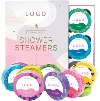


For a shower steamer brand, fragrance is not simply one line on a specification sheet. It often defines the SKU, the packaging language, the collection structure and the experience customers expect before they ever use the product.
Eucalyptus, lavender and menthol may all sit within the same shower steamer category, but they create very different sensory expectations. A eucalyptus-led product usually communicates freshness quickly. Lavender can support a softer, more aromatic direction. Menthol adds a stronger cooling sensory character, while a custom fragrance blend can give a collection an identity that belongs to the brand rather than to the category.
That makes fragrance development a commercial decision as much as a formulation decision.
A brand needs to decide not only which scents it likes, but which fragrance should lead the collection, how the supporting SKUs differ from one another, whether essential oils or broader fragrance systems better fit the concept, and how each scent performs once it is incorporated into the finished tablet.
This guide looks at those decisions from a private label product-development perspective.
For the broader planning process, see our Private Label Shower Steamers Guide.
Why Fragrance Architecture Matters for a Shower Steamer Brand
A shower steamer range does not become stronger simply because it contains more fragrances.
For a new collection, six similar scents can be harder to understand than three or four clearly differentiated directions. The first question should therefore be what role each fragrance plays within the range.
One SKU may act as the recognizable hero product. Another may offer a softer alternative. A third can introduce a different fragrance family, while seasonal or limited blends can add variety without making the permanent range unnecessarily large.
This matters for merchandising as well as product development.
A recognizable eucalyptus SKU can support a fresh herbal direction. Lavender can create contrast with a softer aromatic profile. A citrus or woody blend may expand the range into a different lifestyle or premium position. Several of these fragrances can then be combined into a discovery set without requiring a completely different manufacturing platform.
Fragrance architecture also affects packaging.
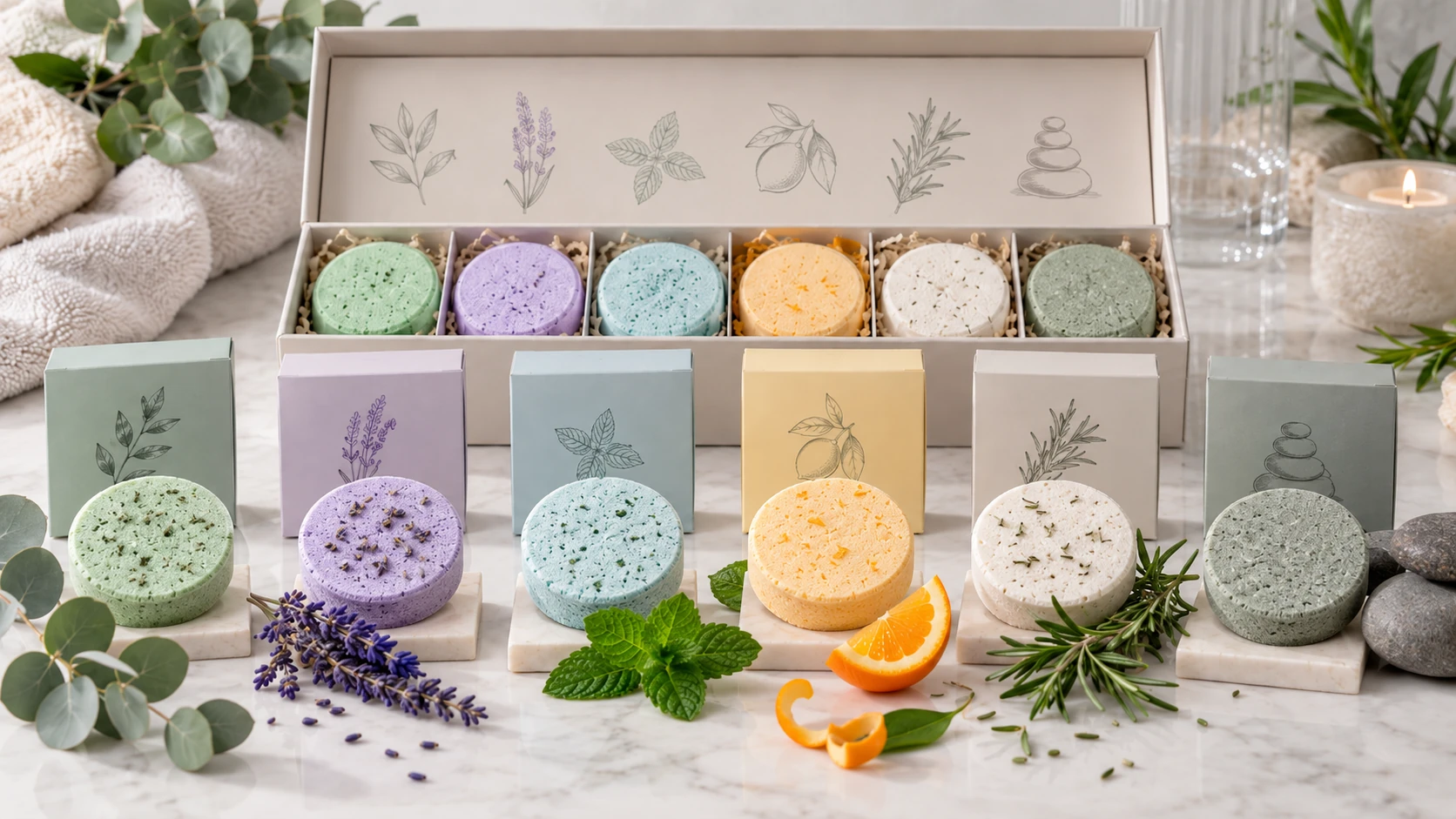
A collection in which every SKU uses a different color, graphic language and scent story may feel fragmented. A stronger approach is usually to maintain a consistent brand system while using fragrance names, color cues and botanical details to distinguish individual products.
The objective is not to create the largest fragrance menu.
It is to create a range that customers can understand and recognize.
Eucalyptus Shower Steamers: Building a Fresh Herbal Hero SKU
Eucalyptus is one of the most recognizable fragrance directions in the shower steamer category.
Its green, aromatic and camphoraceous character is easy to identify in a warm shower environment, which makes it relatively simple to communicate through product names, imagery and retail descriptions.
That recognizability can make eucalyptus useful as a hero fragrance for a new range.
The more important development question is what should surround the eucalyptus note.
Used on its own, the profile can sometimes feel sharp or overly medicinal depending on the material and concentration. Supporting notes can change the character significantly.
Eucalyptus with peppermint creates a crisp, fresh direction. Pairing it with lavender softens the profile and moves the fragrance closer to a spa-inspired position. Lemon or other citrus notes can make it brighter, while cedarwood or similar woody notes can create a more refined, less obviously botanical result.
For private label development, this means "eucalyptus" is only the starting point.
The finished fragrance architecture determines whether the product feels fresh, botanical, premium, clinical or lifestyle-oriented.
That distinction becomes particularly important when several brands are using the same recognizable hero note.
A product that simply smells like generic eucalyptus can easily become interchangeable. A product built around a more deliberate eucalyptus accord has a better chance of supporting a recognizable collection.
Brands already planning this type of SKU can also explore our eucalyptus shower steamers range for private label product options.
Lavender Shower Steamers: Moving Beyond a Generic Lavender SKU
Lavender has the opposite commercial challenge.
The fragrance is already highly familiar across candles, bath salts, pillow sprays, soaps and personal care products. That familiarity makes it easy for consumers to understand, but it also means a generic lavender fragrance can feel indistinguishable from dozens of other products.
For shower steamers, lavender often fits softer aromatic, spa-inspired, gifting and evening-oriented collections.
Differentiation usually comes from the supporting notes.
Lavender combined with chamomile can create a gentle botanical profile. Bergamot can add brightness and a more modern premium character. Vanilla introduces warmth, while cedarwood or sandalwood can shift the fragrance toward a more unisex or sophisticated direction.
The supporting accord should also fit the broader brand.
A clean, minimalist personal care brand may want a very different lavender expression from a traditional botanical spa brand. The first may prefer a restrained aromatic accord; the second may want the botanical character to remain obvious.
This becomes even more useful when fragrance is shared across categories.
A well-developed lavender accord can potentially influence a shower steamer, body wash, bath product or home-spa collection, creating stronger fragrance recognition across multiple SKUs.
Marketing language should remain focused on the sensory experience.
Phrases such as evening-inspired, soft aromatic, spa-like lavender fragrance or relaxing atmosphere communicate positioning without turning the product description into a medical claim.
Brands developing a lavender-led SKU can also explore our lavender shower steamers range for private label product and fragrance options.
Menthol Shower Steamers: Managing Sensory Intensity
Menthol affects the shower experience differently from fragrance alone.
It creates a recognizable cooling sensory character, which can make a shower steamer feel more immediate and high-impact.
That makes menthol suitable for fresh product concepts, men's care collections, fitness-oriented ranges and seasonal launches where the brand wants the product experience to feel more intense than a soft aromatic fragrance.
Eucalyptus and menthol are often paired because their sensory characters complement each other.
However, increasing menthol does not automatically improve the product.
If the menthol level dominates the fragrance, the product can lose the more nuanced character created by eucalyptus, woods, citrus or herbs. A very aggressive sensory profile can also narrow the intended audience.
The balance therefore needs to be evaluated in the finished tablet.
Tablet size, water contact, fragrance composition and the shower environment can all influence how the menthol character is perceived.
A well-developed menthol shower steamer should have a clear sensory identity without making the fragrance architecture disappear behind one overwhelming note.
For brands, the useful question is not:
How much menthol can we add?
It is:
How much sensory impact does this particular product concept need?
Essential Oils, Fragrance Oils or a Hybrid System?
One of the most common fragrance-development questions is whether a shower steamer should use essential oils or fragrance oils.
There is no universal answer because the two approaches solve different commercial problems.
| Fragrance System | Main Advantage | Main Consideration | Suitable Positioning |
|---|---|---|---|
| Essential Oil-Led | Recognizable botanical ingredient story | Narrower fragrance palette and material variability | Natural-inspired, botanical or premium wellness |
| Fragrance-Led | Broader creative range and greater scent-design flexibility | Less dependent on a botanical hero ingredient | Lifestyle, gifting, seasonal and mass-premium ranges |
| Hybrid System | Combines recognizable botanical notes with broader fragrance design | Requires careful formulation, documentation and testing | Signature private label collections |
Essential oils can give a product a clear ingredient story. Eucalyptus, lavender, peppermint and rosemary are names consumers already understand, and that familiarity can support botanical positioning.
Fragrance systems allow much wider creative freedom.
They can create complex spa accords, woods, florals, fruits and seasonal directions that may be difficult, inconsistent or commercially impractical to build entirely from essential oils.
For many private label projects, however, the decision is not simply "essential oil or fragrance."
A hybrid approach may be more useful.
A fragrance could retain eucalyptus essential oil as a recognizable botanical component while using a broader fragrance structure to create better differentiation and a more defined scent identity.
The brand still gains a botanical story, but the fragrance team is not limited to reproducing the smell of one raw material.
Regardless of the approach, "natural" should not be treated as a substitute for safety or documentation review. The finished fragrance system still needs to be evaluated for the intended product and target market.
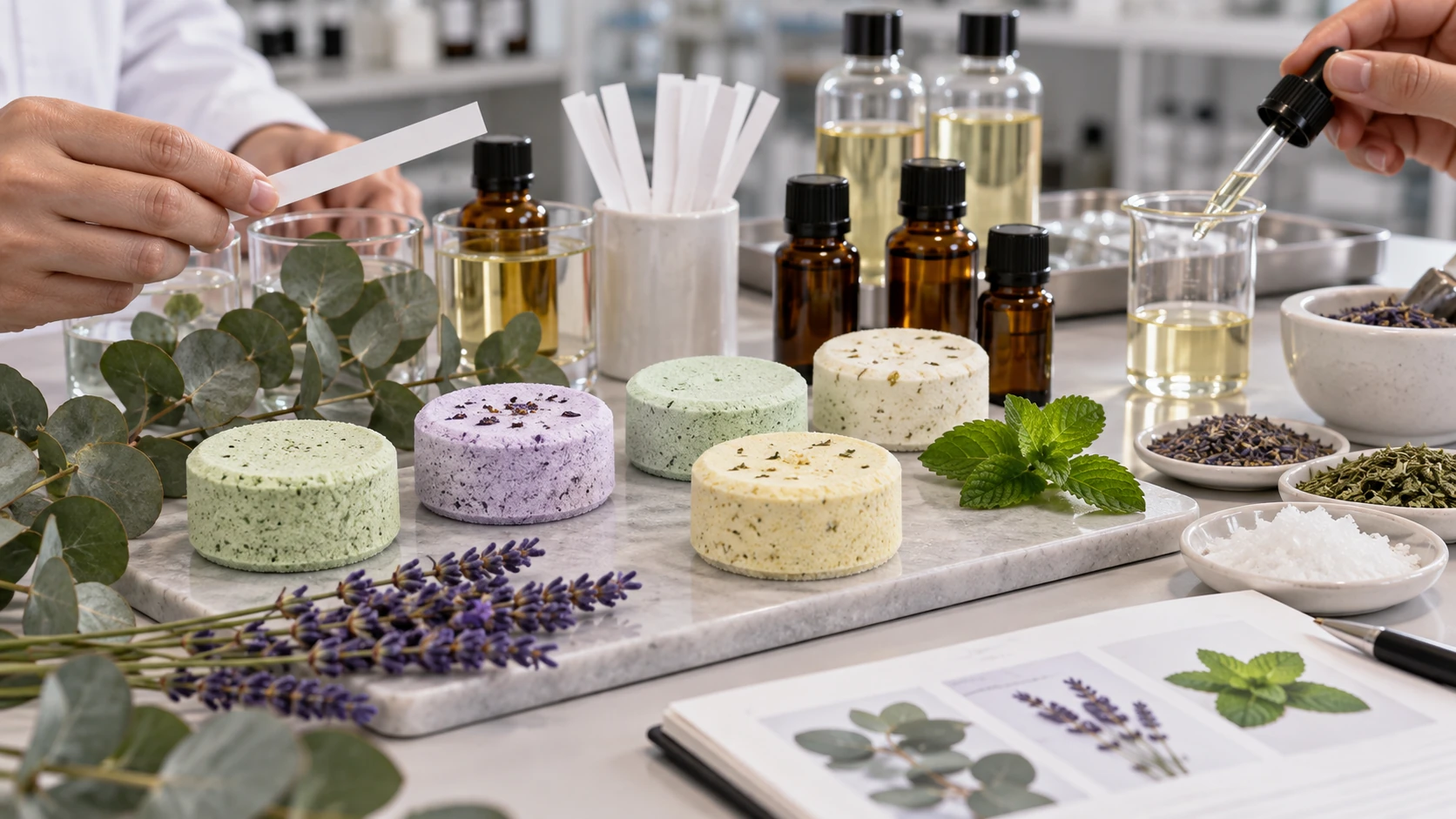
How to Write a Useful Shower Steamer Fragrance Brief
A good fragrance project rarely begins with:
"We need lavender."
That tells the development team what ingredient or fragrance family the brand recognizes, but very little about the product it is trying to create.
A more useful brief might be:
We want an evening shower fragrance with a bright bergamot opening, a recognizable lavender heart and a soft cedarwood finish. It should feel clean and modern rather than sweet or traditional.
That brief gives the fragrance team several useful pieces of information at once.
It explains the intended use occasion, the hero note, supporting fragrance structure and the type of character the brand wants to avoid.
Price position matters as well.
A fragrance being developed for a premium hotel or spa program may require a different structure from one intended for high-volume marketplace retail. The same applies if the fragrance will eventually extend into body care, soap or home fragrance.
Reference products can also help, but brands should describe what they like about the reference rather than simply asking a factory to copy it.
"Clean woody drydown," "lighter lavender," or "less sweet and more herbal" gives the development team more direction than a product name alone.
The stronger the brief, the easier it becomes to compare samples meaningfully.
Custom Shower Steamer Blend Concepts
Custom blends allow a brand to move beyond the standard single-note fragrance assortment.
The following concepts are starting directions rather than finished fragrance formulas.
| Concept | Fragrance Direction | Suggested Notes | Brand Position |
|---|---|---|---|
| Morning Reset | Fresh herbal citrus | Eucalyptus + Peppermint + Lemon | Everyday fresh |
| Night Ritual | Soft aromatic | Lavender + Chamomile + Cedarwood | Evening-inspired |
| Forest Spa | Green woody | Eucalyptus + Rosemary + Pine | Natural premium |
| Cooling Steam | High-impact fresh | Menthol + Eucalyptus + Mint | Strong sensory |
| Citrus Garden | Bright botanical | Bergamot + Lemon + Rosemary | Unisex lifestyle |
| Modern Spa | Aromatic woody | Lavender + Eucalyptus + Sandalwood | Premium spa / hotel |
These combinations should be treated as fragrance directions rather than fixed recipes.
Changing the proportion or character of one supporting note can shift the finished product considerably.
The same "eucalyptus + lemon" idea, for example, could become a sharp herbal-citrus product or a soft contemporary spa accord depending on the materials used and the balance between them.
This is where custom fragrance development creates more value than simply choosing from a standard scent list.
Fragrance Must Be Tested in the Finished Tablet
A fragrance that smells excellent in a bottle does not automatically perform well in a shower steamer.
The fragrance interacts with the tablet.
Volatility, tablet density, water access, dissolution behavior, menthol and packaging can all influence the sensory result once the product is used.
A strongly scented dry tablet may produce only a moderate aroma in the shower. Another fragrance may seem less intense in the package but become much more noticeable once warm water reaches the product.
This is why fragrance approval should happen in the intended finished format.
If a brand changes tablet weight, shape, hardness or fragrance system after approving the scent, the aroma experience may need to be checked again.
Humidity and packaging also matter because fragrance performance can change during storage if the tablet or fragrance system is not adequately protected.
These relationships are covered in more depth in our Shower Steamer Formula Guide: Fizz, Hardness, Aroma Release and Humidity Control.
For this fragrance-focused project, the main point is simpler:
approve the scent in the product customers will actually use.
How to Evaluate a Shower Steamer Fragrance Sample
When a fragrance sample arrives, the first reaction is usually:
Do I like the smell?
That matters, but it is only the beginning.
The dry fragrance gives the brand an initial impression of what the customer may notice when opening the package. The in-shower evaluation shows whether the character remains recognizable once water, steam and ventilation change the environment.
The brand should also compare the sample with the other planned SKUs.
If eucalyptus, mint and menthol all smell almost identical in use, the collection may not have enough differentiation. If every fragrance has a completely different style, the range may lack a recognizable brand identity.
Menthol-based products need an additional check: whether the cooling sensory character supports the fragrance or overwhelms it.
Packaging should also be part of the sample review. A fragrance that performs well immediately after production should still remain acceptable after spending time in its intended packaging.
A useful fragrance approval therefore considers dry character, in-shower performance, SKU differentiation, sensory balance and stability, rather than relying on one quick smell from the sample bag.
Building a Cohesive Fragrance Collection
A new brand does not need ten scents to appear established.
A smaller collection can often communicate the positioning more clearly.
One approach is to begin with three distinct roles.
A fresh herbal hero SKU might lead the line. A softer aromatic profile can provide contrast, while a third fragrance from a different family-citrus, woody or seasonal-adds range without making the assortment difficult to understand.
A fourth SKU can then be used as a signature or seasonal blend.
This structure also makes shower steamer gift sets easier to develop, because each fragrance can contribute a clearly different role to the collection.
Instead of filling a box with six variations of the same fragrance direction, the brand can create a discovery experience in which each tablet clearly contributes something different.
Reorder data can guide future expansion.
If one fragrance becomes the clear hero product, the brand may build additional products or variations around that scent. If a seasonal blend consistently performs well, it may justify moving into the permanent collection.
Fragrance architecture should be allowed to evolve from actual sales rather than being overbuilt before launch.
Adapting Fragrance Direction to Market and Sales Channel
There is no fragrance assortment that should automatically be launched unchanged in every market.
Sales channel, retail positioning and existing brand identity all matter.
For North American e-commerce, recognizable directions such as eucalyptus, lavender, mint and multi-fragrance gift sets can make the proposition easier to communicate in search results and product imagery.
Premium spa or boutique programs may benefit from more layered aromatic or woody profiles, where the fragrance itself helps justify a higher-value position.
Natural-inspired beauty concepts may place more emphasis on botanical hero materials and ingredient transparency.
Other markets may respond well to lighter citrus, tea-inspired, green or sophisticated woody structures, but these should be treated as product-development hypotheses rather than universal regional rules.
A brand selling through Amazon may need a fragrance name that customers immediately recognize.
A premium hotel program may value a more distinctive signature scent.
A DTC brand with an established fragrance identity may want the shower steamer to connect with products already in its range.
For that reason, market selection should influence the fragrance brief rather than be added after the scent is already approved.
Fragrance Documentation and Claims Matter
Fragrance development is also a documentation and marketing-language project.
For international private label programs, brands should confirm which fragrance information is available for the intended product and destination market. Depending on the project, this may include relevant IFRA conformity information, allergen information and other fragrance documentation.
Requirements should be reviewed in the context of the actual finished product rather than assuming one document covers every use.
Claims deserve the same attention.
A phrase such as:
Refreshing eucalyptus and menthol aroma for a fresh shower experience
describes the sensory positioning.
A statement such as:
Relieves nasal congestion
makes a very different type of claim.
The distinction matters because product classification and regulatory requirements can be affected by intended use and marketing claims.
The same applies to lavender.
A brand can position a product around an evening ritual, soft aromatic experience or spa-inspired fragrance without claiming that the product treats anxiety or insomnia.
Good fragrance marketing should communicate the experience customers can expect without creating unnecessary regulatory exposure.
From Fragrance Brief to a Production-Ready SKU
Once the fragrance direction is clear, development usually moves through three broad stages.
The first is the brief.
The brand defines the target customer, fragrance role, hero notes, positioning and anything the scent should avoid.
The second is finished-product evaluation.
Fragrance samples are incorporated into the actual shower steamer base so the brand can judge aroma release, sensory balance and interaction with the tablet rather than approving the raw fragrance in isolation.
The final stage is production confirmation.
The approved fragrance, tablet format and packaging become part of the production reference. Relevant fragrance documentation is reviewed, and any material changes to the fragrance or product format can be evaluated before bulk manufacturing.
This sequence reduces a common sourcing problem: choosing a scent because it smells attractive in a sample bottle, only to discover that it behaves differently once incorporated into the commercial product.
Frequently Asked Questions About Aromatherapy Shower Steamers
Q: 1. What fragrance directions are good starting points for a new shower steamer range?
A: Eucalyptus, lavender, mint, citrus and selected menthol combinations are recognizable starting directions. A new brand does not necessarily need a large assortment; a smaller range of clearly differentiated fragrance families can be easier to position and test.
Q: 2. Are essential oil shower steamers better than fragrance-based products?
A: Not necessarily. Essential oils can support botanical positioning, while fragrance systems provide greater creative range and scent consistency. A hybrid system can also be useful when a brand wants a recognizable botanical component together with a more distinctive fragrance architecture.
Q: 3. Can eucalyptus and menthol be used together?
A: Yes. They can create a clear fresh and cooling sensory direction, but their balance needs to be evaluated in the finished tablet. Too much menthol can dominate the fragrance and make the product unnecessarily intense.
Q: 4. Can a brand develop an exclusive shower steamer fragrance?
A: Yes. A custom fragrance can be designed around a defined scent brief, including top, middle and base-note directions, target positioning and references. This gives the brand more differentiation than relying only on standard fragrance options.
Q: 5. How many fragrances should a new shower steamer collection launch?
A: There is no fixed number. For many new collections, a smaller range of clearly differentiated SKUs is easier to merchandise and evaluate than a large launch with many similar scents. Additional fragrances can be developed after the brand has useful sell-through and reorder data.
Q: 6. What should buyers evaluate before approving a fragrance sample?
A: Evaluate the dry aroma, in-shower fragrance character, sensory intensity, differentiation from other SKUs and performance in the intended product and packaging. The final decision should be based on how the fragrance works in the finished tablet rather than the raw fragrance alone.
Develop a Signature Shower Steamer Fragrance Collection
A recognizable shower steamer range starts with clear fragrance roles rather than a long list of unrelated scents.
Eucalyptus can lead a fresh herbal direction. Lavender can support a softer aromatic range. Menthol can add a stronger sensory signature, while custom fragrance blends can give the collection an identity that belongs to the brand.
If you already have a target customer, fragrance direction or reference scent, the next step is to translate that idea into finished shower steamer samples and evaluate the fragrance in the actual tablet and packaging format.
Poleview supports private label shower steamer development across fragrance selection, custom blends, tablet customization, packaging and commercial production.