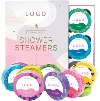


A commercial shower steamer formula has to do more than fizz.
The tablet needs to survive pressing, packing, warehousing and transport, then respond consistently when water reaches it in the shower. At the same time, it has to release enough fragrance to create the intended experience without becoming too fragile, too dense or too sensitive to moisture.
That is why commercial formula development is very different from following a home recipe.
The acid–carbonate system matters, but so do particle characteristics, structural materials, fragrance loading, tablet size, compression, production humidity and packaging. Change one of those variables and the finished product may behave differently even when the ingredient list remains almost the same.
For a private label brand, the goal is therefore not to find one "perfect" formula. It is to develop a product in which fizz, tablet strength, aroma release and moisture stability work together, then confirm that the same performance can be reproduced during bulk production.
For the broader planning process, see our Private Label Shower Steamers Guide, which covers fragrance, packaging, product-line development and manufacturing alongside formula decisions.
What a Commercial Shower Steamer Formula Needs to Do
Most shower steamers use an effervescent system built around sodium bicarbonate and an acid such as citric acid. When enough water reaches the tablet, the reaction releases carbon dioxide and the tablet begins to break down.
That reaction is only one part of the finished product.
A retail-ready shower steamer also needs enough mechanical strength to survive handling. It needs to respond predictably in use, carry the intended fragrance profile and remain stable before the customer opens the package.
Those requirements can work against each other.
A more porous tablet may allow water to penetrate quickly but may also be more vulnerable to edge damage. Increasing compression may improve physical strength while changing how quickly the product activates. Adding more fragrance can change the behavior of the powder during pressing as well as the sensory result.
This is why formula approval should be based on the finished scented tablet, not simply on an ingredient list or an unscented laboratory base.
Before development begins, the product brief should already give the manufacturer a clear idea of the intended tablet weight, shape, fragrance direction, packaging format, target market and distribution conditions. Those details affect how the formula should be tested.
How a Commercial Shower Steamer Formula Is Structured
There is no universal formula that works equally well for every fragrance, mold and market.
A more useful way to think about the formulation is by function.
| Functional Block | Role in the Product | Main Development Question |
|---|---|---|
| Effervescent System | Creates the water-activated reaction | How consistently should the tablet activate and break down? |
| Structural System | Supports pressing, handling and transport | Is the tablet strong enough without becoming excessively dense? |
| Fragrance System | Delivers the intended aroma profile | Does the finished tablet release fragrance effectively during use? |
| Sensory Components | Supports cooling, botanical or other product concepts | Does the sensory profile suit the intended positioning and market? |
| Process Aids & Appearance | Supports flow, compression, color and consistency | Can the product be reproduced reliably during commercial production? |
The exact percentages behind these blocks are established through trials rather than copied from a standard recipe.
Raw-material grade alone can make a noticeable difference. Particle size affects powder flow and surface contact. Fragrance can change compression behavior. A heavier or thicker tablet changes water access. Even after the formula is finalized, packaging can influence how well the product performs after several months of storage.
For commercial development, the formula is therefore better understood as a combination of materials, dimensions and process parameters rather than a fixed list of percentages.
Fizz Depends on More Than the Acid-to-Base Ratio
Sodium bicarbonate and citric acid form the main reactive pair in many effervescent tablets.
For anhydrous citric acid and sodium bicarbonate, the stoichiometric relationship provides a useful chemical reference. One published 2026 study on effervescent tablets identified an optimized mass relationship of approximately 1:1.312 for citric acid to sodium bicarbonate.
That figure should not be treated as a recommended shower steamer ratio.
Commercial shower tablets may intentionally use a different balance depending on the complete formula, processing requirements and desired product behavior. The more useful question is how that chemistry performs once it has been compressed into the intended finished tablet.
Particle characteristics make a difference as well.
A finer powder can create more contact area, but particle distribution also changes flow, compressibility and the route water takes through the tablet. Two batches with apparently identical percentages may therefore react differently if the raw-material grade changes.
Water access is equally important.
A dense tablet with limited porosity may respond differently from a more open structure even when both use the same acid–carbonate system. That is why fizz should be evaluated on the production-format tablet rather than predicted from formula percentages alone.
For buyers reviewing samples, the practical question is simple:
Does the finished tablet activate consistently under the intended shower conditions?
That is more useful than asking whether a supplier uses one particular ratio.
Shower Steamer Hardness Is a Balance, Not a Maximum
Shower steamer hardness does not come from one "hardening ingredient."
It develops from the interaction between the powder system, structural materials, binder level, liquid load, moisture, tablet geometry and compression conditions.
The tablet needs enough physical integrity to survive normal production and distribution. Edge chipping, cracks or broken pieces may seem minor during early sampling, but they become much more significant once products are packed by the thousand or shipped through e-commerce and export channels.
At the same time, making the tablet as hard as possible is not the answer.
Higher compression or excessive structural support can reduce porosity and alter the way water reaches the reactive matrix. A tablet may become more resistant to breakage but less responsive in use.
Fragrance and essential oils can also influence compression behavior. A base that presses well before scent is added may behave differently once the final fragrance system is incorporated.
For this reason, physical strength should always be checked on the finished scented sample.
The commercial target is not maximum hardness. It is enough strength to survive production and distribution without compromising the intended activation behavior.
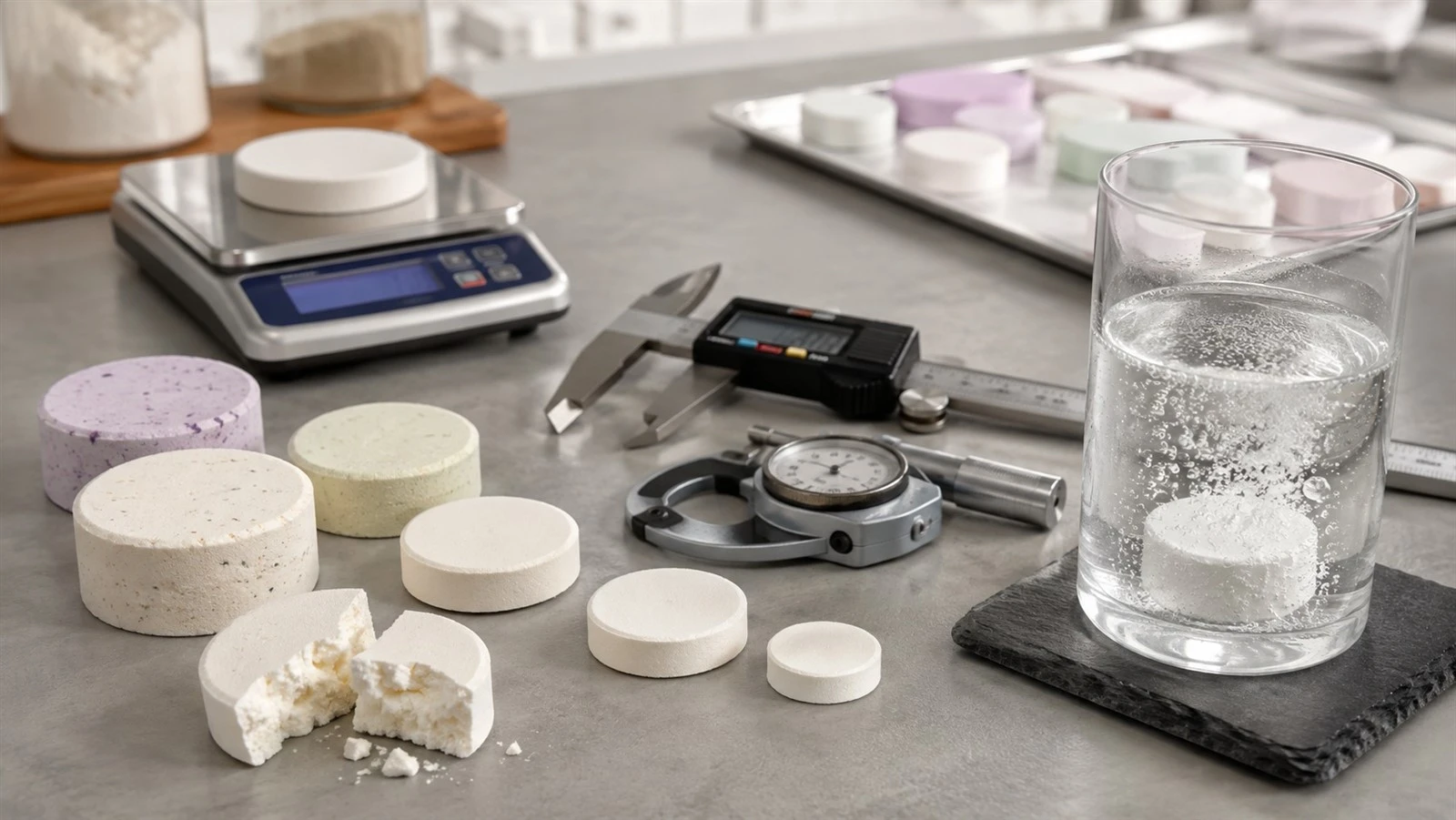
Tablet Size and Shape Can Change the Same Formula
Changing the shape of a shower steamer is not purely a branding decision.
Diameter, thickness, density and exposed surface area all affect the path water takes through the tablet.
Published research on pharmaceutical effervescent tablets illustrates how significant this effect can be. One study found that changing tablet dimensions while maintaining comparable mechanical conditions produced substantial changes in measured effervescence time.
The research was not carried out on shower steamers, so the numerical result should not be turned into a shower steamer specification. The underlying physical principle is still useful: geometry changes activation.
This becomes relevant when a brand moves from a standard round tablet to a thicker custom mold, increases product weight or adds deeper embossing.
Those changes can affect surface area, water penetration, density distribution, demolding and edge strength. A visually attractive design may therefore require adjustment to the formula or press settings before it is ready for bulk production.
A brand should ideally approve the product in the final commercial shape and weight. Approving a small standard puck and later changing to a larger custom mold is not simply a packaging or design change.
It is a new performance variable.
Aroma Release Is Not Simply a Fragrance Percentage
Fragrance is often the reason customers notice a shower steamer in the first place, but perceived aroma does not rise in a straight line with fragrance loading.
Different fragrance materials have different volatility and note structures. Some create a stronger early impression; others are softer or develop more gradually.
Essential-oil-led products, including fragrance directions used in eucalyptus shower steamers, and broader fragrance-based systems can support different brand positions. The choice may depend on scent character, consistency, documentation, cost and the intended collection rather than on one system being universally better.
The tablet itself also influences fragrance delivery.
If the product responds very quickly to water, the aroma may be released over a shorter period. A slower-changing structure may create a different sensory profile. The interaction between fragrance and tablet performance is why fragrance development should happen within the finished formula rather than separately.
The shower environment adds another variable. Ventilation, water temperature, direct water contact and product placement can all change what the customer perceives.
A fragrance that smells powerful when the dry tablet is held close to the nose may perform very differently on a shower floor.
For private label projects, the meaningful test is therefore the aroma of the finished product in use.
Where relevant, brands should also review supporting fragrance documentation such as IFRA information and allergen data. Marketing language deserves the same care. A "fresh" or "spa-inspired" sensory concept is different from making therapeutic or medical claims.
Humidity Can Change the Product Before It Is Ever Used
Humidity is one of the most important stability variables in an effervescent product.
Citric acid and sodium bicarbonate are intended to react when enough moisture is present. If uncontrolled moisture enters the system during production or storage, part of that process can begin before the customer ever uses the tablet.
The consequences may appear as surface changes, swelling, cracking, reduced physical integrity or weaker activation.
Moisture can enter at several stages: raw-material storage, mixing, compression, temporary storage before packing or finished-product distribution.
This is why humidity control begins in manufacturing rather than at the warehouse door.
One published direct-compression study on pharmaceutical effervescent tablets carried out processing under relative humidity below 35%. That figure should not be interpreted as a universal shower steamer factory specification. What it demonstrates is that controlled environmental humidity is a genuine process consideration for moisture-sensitive effervescent systems.
A manufacturer therefore needs to understand not only how the formula reacts to water in the shower, but also how long the product remains exposed before final protective packaging.
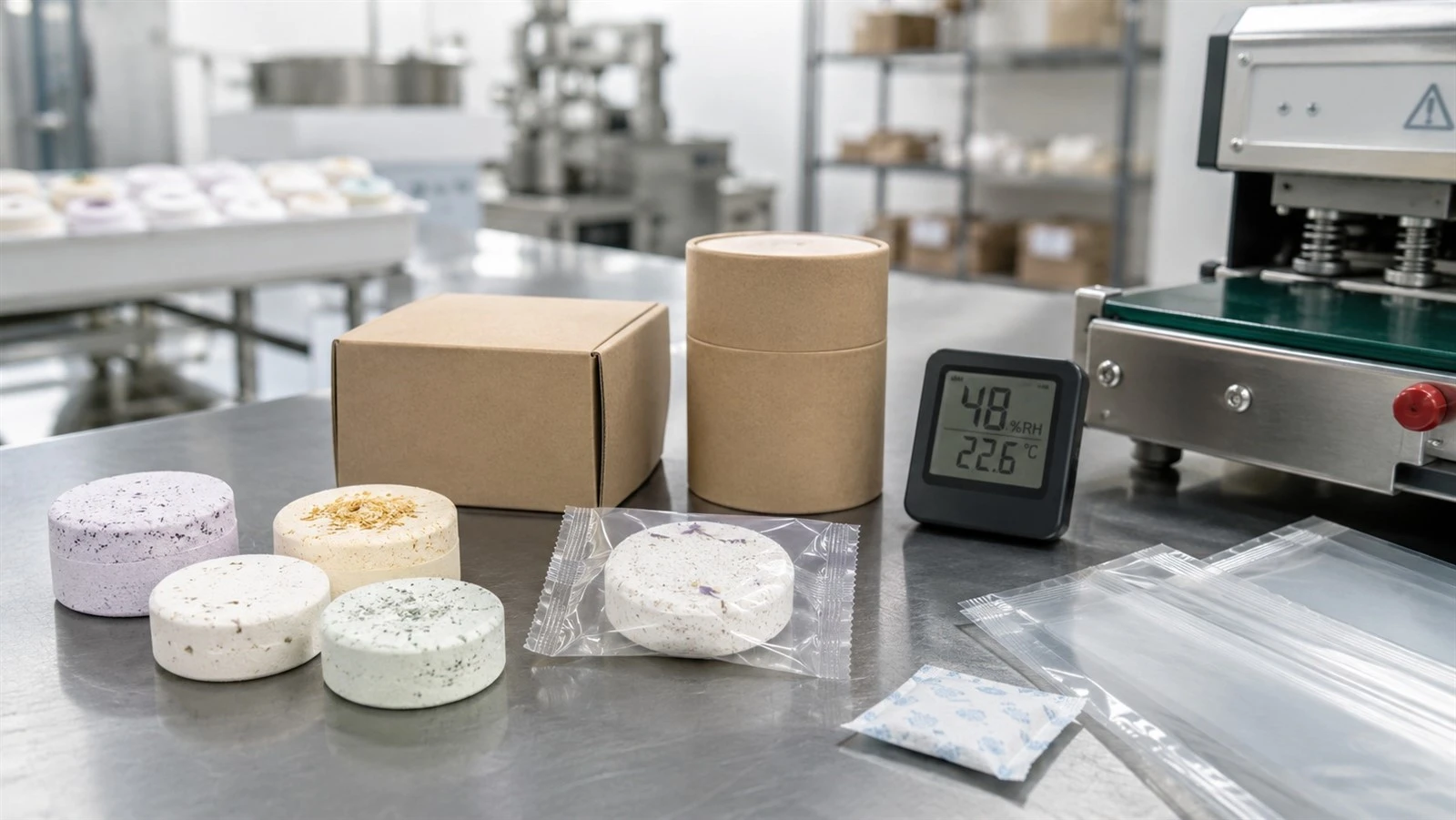
Packaging is part of the stability system
A tablet can perform perfectly when tested directly after pressing and still fail later if its packaging allows too much moisture exposure.
That is especially relevant for long storage periods, humid climates and international sea freight.
Depending on the project, manufacturers may evaluate individual wraps, sealed pouches, tubes, jars or other barrier formats. The right solution depends on the formulation, sales channel, expected storage conditions and retail presentation.
Paper packaging can be valuable for branding, but attractive outer packaging should not automatically be assumed to provide the moisture protection required by the tablet.
The detailed packaging decision belongs in the separate Shower Steamer Packaging Guide, but formula development still needs to take the final pack into account.
How to Evaluate a Shower Steamer Sample
A good-looking sample is not automatically a good production sample.
Brands often focus first on fragrance, color and appearance. Those matter, but the sample also needs to show whether the product can realistically become a repeatable commercial SKU.
| What to Check | What the Brand Should Evaluate |
|---|---|
| Tablet Integrity | Edge damage, cracks, chips and handling strength |
| Activation | How consistently the tablet responds to shower water |
| Aroma Release | Fragrance strength, character and consistency during use |
| Appearance | Surface finish, color and consistency between tablets |
| After Storage | Whether physical or in-use performance changes over time |
| Packaging Fit | Whether the selected pack protects the tablet and matches its final dimensions |
The sample should ideally use the intended fragrance, weight and tablet format.
An unscented base does not fully validate a scented production formula. A standard mold does not fully validate a custom shape. A tablet tested without its intended packaging does not fully validate the final retail product.
This becomes even more important when a project involves gift boxes, individual protective packaging, custom printing or long international distribution.
Sampling should create a production reference, not merely a visual concept.
Once the brand approves that reference, the factory has something concrete to reproduce.
From a Good Sample to Repeatable Bulk Production
A commercial formula has to work more than once.
Laboratory-scale development may involve small mixers, manual handling and short processing times. Bulk production introduces different equipment, larger material volumes and longer exposure periods.
A larger mixer can change ingredient distribution. Industrial compression equipment may create a different density profile. Longer processing can increase environmental exposure. Packaging speed also changes the length of time finished tablets remain outside their protective pack.
That is where small-batch recipes often begin to show weaknesses.
Once the preferred sample is approved, the production team should identify the parameters that materially affect finished performance. These can include raw-material grade, mixing sequence, fragrance-addition stage, tablet dimensions, compression settings, environmental moisture exposure and the timing of final packaging.
The goal is not simply to reproduce the same appearance.
It is to reproduce the characteristics the brand approved.
That becomes particularly important on repeat orders. A reorder several months later should not require the supplier to "recreate" the original result from memory.
For brands ready to move from formula planning into samples and production, our private label shower steamer manufacturing services cover product development, customization, packaging and commercial manufacturing.
Formula Performance Should Match the Brand Position
There is no single shower steamer formula that can be called the best for every market.
A premium spa product may place more emphasis on refined fragrance, controlled activation and clean appearance. A fresh, high-impact concept may prioritize a more immediate sensory impression.
Essential-oil-led ranges may require closer attention to scent character, raw-material documentation and stability. E-commerce products may need greater physical robustness because individual parcels experience different handling from shelf-based retail.
Large retail programs often put more emphasis on repeatability, production efficiency and cost consistency. Products sold into humid markets may require more attention to moisture stability and packaging protection.
These priorities influence the formula brief.
That is why asking a manufacturer for "your standard shower steamer formula" is usually less useful than explaining what the finished product is expected to achieve.
A strong development brief connects product positioning with measurable product behavior.
What Published Effervescent Research Can - and Cannot - Tell Us
Research on pharmaceutical effervescent tablets is useful because the underlying systems share some engineering principles with shower tablets.
It can help explain why acid–carbonate balance, compression, geometry and humidity matter.
It cannot provide ready-made shower steamer specifications.
For example, the 2026 study cited in this article reported an optimized citric-acid-to-sodium-bicarbonate relationship of approximately 1:1.312, together with 53 N hardness, 0.6% friability and 72-second disintegration for its optimized pharmaceutical tablet.
Those values are not recommended targets for shower steamers.
Their relevance is that the study measured mechanical strength and activation together rather than treating them as independent characteristics.
Likewise, the 2014 direct-compression research used manufacturing conditions below 35% relative humidity and investigated how changes in tablet dimensions influenced effervescence behavior.
Again, the useful lesson is not "manufacture every shower steamer below 35% RH."
The lesson is that environmental moisture and tablet geometry are controllable engineering variables capable of changing the finished product.
For shower steamer developers, published research provides context. The actual specification still has to be established through trials using the intended formula, fragrance, tablet format and packaging.
What to Ask a Shower Steamer Development Partner
Supplier evaluation becomes more useful when the conversation moves beyond available scents and unit price.
Ask whether pilot samples can be produced in the intended commercial size and fragrance rather than only in a standard laboratory format. Ask how raw-material grades and tablet dimensions are controlled between batches, and how environmental humidity is managed before the product reaches its final packaging.
It is also worth understanding what the factory actually checks on the finished tablet. Appearance alone is not enough if the project depends on consistent tablet integrity and in-use performance.
For fragrance-led projects, confirm what supporting documentation is available where relevant and whether changes in fragrance, mold, tablet weight or packaging will trigger additional testing.
A supplier that can explain what needs to be controlled and why is usually giving you more useful information than one that simply offers a long list of standard formulas.
Frequently Asked Questions
Q: 1. What is the best baking soda-to-citric-acid ratio for a shower steamer?
A: There is no single best commercial ratio. The stoichiometric relationship between anhydrous citric acid and sodium bicarbonate provides a useful chemical reference, but the finished product may intentionally use a different balance depending on formulation, tablet format and performance targets. The actual ratio should be validated in the finished scented tablet.
Q: 2. How do manufacturers improve shower steamer hardness without slowing the fizz too much?
A: They usually adjust powder characteristics, structural materials, binder, moisture and compression together. Increasing compression or binder can improve physical strength but may also change porosity and water penetration, so tablet integrity and activation need to be evaluated at the same time.
Q: 3. How much essential oil should a shower steamer contain?
A: There is no universal percentage that applies to every oil or product concept. The appropriate amount depends on the material, tablet weight, complete formula, sensory target, market requirements and applicable fragrance guidance. A scent system should be evaluated within the finished product rather than selected from a generic recipe.
Q: 4. Why do shower steamers soften, swell or crack during storage?
A: Moisture exposure can be one cause. Raw-material moisture, production humidity, processing conditions, storage and packaging barrier performance may all influence the result. The cause should be investigated across the formulation and production process instead of being attributed automatically to one ingredient.
Q: 5. Does packaging affect shower steamer formula stability?
A: Yes. A tablet may perform well immediately after manufacture but change later if the packaging allows excessive moisture exposure. Formula, packaging, climate and distribution conditions should therefore be evaluated together.
Q: 6. What should a brand check before approving a shower steamer sample?
A: The review should cover tablet integrity, activation, fragrance performance, appearance and packaging fit. Ideally, the sample should already use the intended fragrance, tablet dimensions and product format so the approved reference is close to what will actually be manufactured.
Develop a Custom Shower Steamer Formula
A reliable shower steamer is not simply citric acid, sodium bicarbonate and fragrance pressed into a tablet.
Commercial development requires the formula, tablet structure, fragrance system, production conditions and packaging to work together.
If your brand already has a fragrance direction, tablet size, packaging concept or performance target, the next step is to turn those requirements into samples that can be evaluated in the intended commercial format.
Poleview supports private label shower steamer development from formula and fragrance sampling through tablet customization, packaging coordination and bulk production.
Explore Shower Steamer Manufacturing
Technical References
[1] Panysheva O. (2026). Pharmaceutical development of composition of effervescent tablets with acetylsalicylic acid, paracetamol and ascorbic acid. Used here as engineering context for acid–carbonate balance, mechanical strength, friability and disintegration.
[2] Khan A. et al. (2014). Application of the SeDeM Expert System in formulation development of effervescent tablets by direct compression. Used here as engineering context for controlled-humidity processing and tablet-geometry effects.
Note: Both references concern pharmaceutical effervescent tablets rather than shower steamers. Their data are included as technical context and should not be treated as direct shower steamer specifications.