

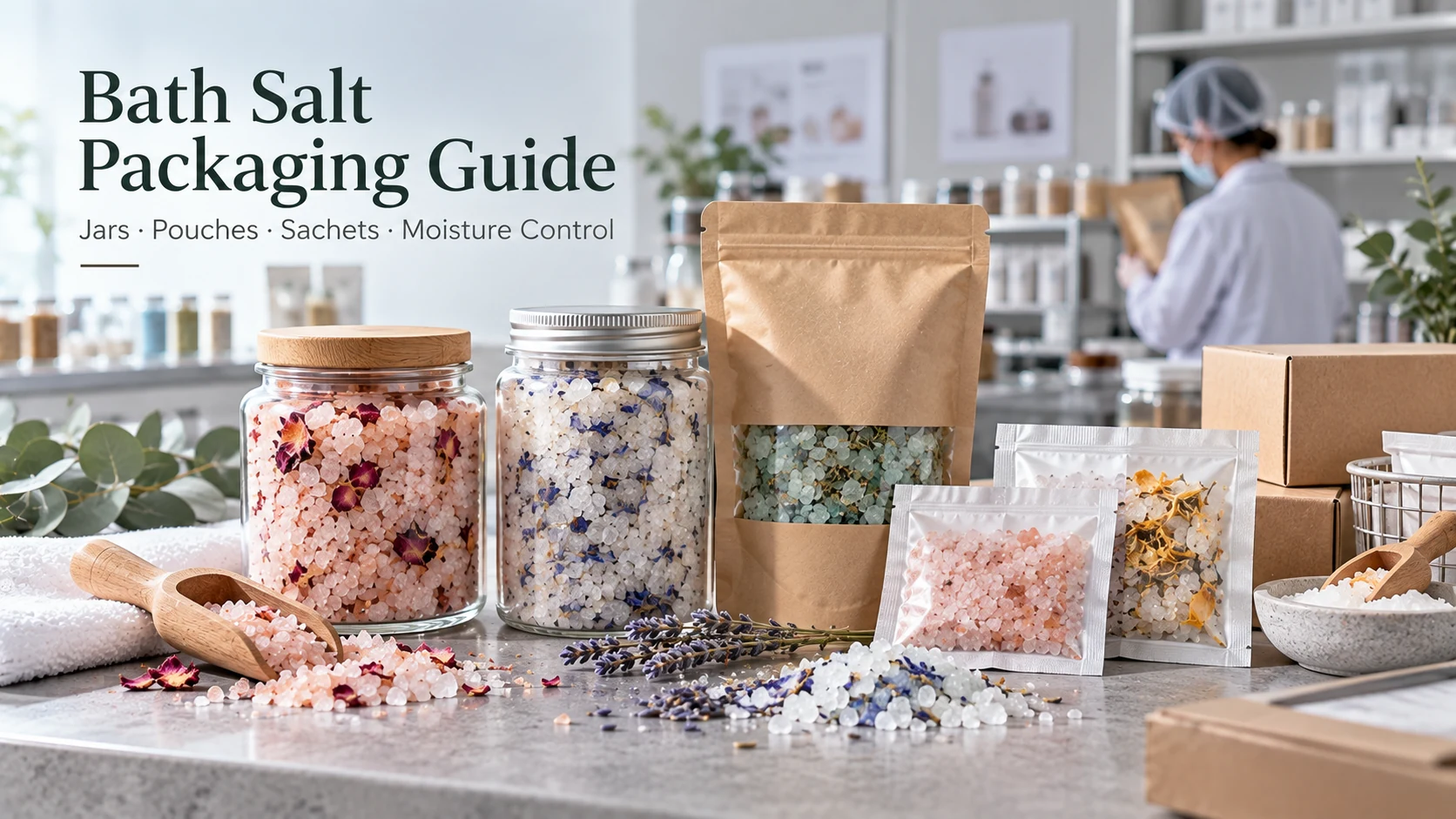
Bath salt packaging has to do more than look attractive.
For a private label brand, the package needs to protect the salt from moisture, maintain fragrance quality, work with the filling process, survive storage and shipping, and support the intended retail position.
A premium jar may create stronger shelf presence but increase freight weight. A flexible pouch may be more efficient for e-commerce but depends heavily on barrier performance and sealing quality. Sachets can work well for sampling and single-use formats, while gift sets need an inner packaging system that protects each component during transport.
The right choice therefore depends on the complete product specification rather than packaging appearance alone.
For a broader overview of formula, manufacturing and product development, see our Private Label Bath Salts Guide.
1. What Should Bath Salt Packaging Protect Against?
Bath salts can be sensitive to humidity.
If moisture enters the package, the product may begin to clump, lose flowability or change in appearance. Fragrance performance can also shift during extended storage if the packaging system does not provide adequate protection.
For this reason, bath salt packaging usually needs to balance four practical requirements:
| Packaging Requirement | Why It Matters |
|---|---|
| Moisture Protection | Helps reduce clumping and texture changes |
| Fragrance Retention | Supports a consistent sensory experience |
| Pack Integrity | Reduces leakage or damage during shipping |
| User Convenience | Makes dispensing, resealing and storage easier |
Appearance is important, but it should come after basic product protection.
The best-looking package is not a good solution if the product becomes hard or unstable before it reaches the customer.
2. Jars: Strong Shelf Presence for Premium Products
Jars are commonly used when crystal appearance is part of the product experience.
Clear packaging allows consumers to see salt color, grain size and decorative botanicals, which can be valuable for premium spa, natural or gift-oriented ranges.
Glass jars usually provide the strongest premium impression, while PET or PP formats can reduce shipping weight and breakage risk.
The main trade-off is logistics.
Glass increases carton weight and requires stronger protection during transportation. Wide-mouth jars also need an effective closure and sealing system because the large opening can create a greater moisture-management challenge after filling.
For private label projects, jar selection should therefore consider:
appearance + closure + sealing + freight
rather than appearance alone.
3. Pouches: Efficient for E-Commerce and Larger Pack Sizes
Flexible pouches are often practical for brands that prioritize shipping efficiency, refill formats or larger consumer pack sizes.
Compared with rigid containers, pouches generally use less shipping space and provide a large printable area for branding.
Stand-up pouches can create stronger retail presentation, while flat or refill pouches may be more suitable for cost-sensitive and e-commerce programs.
The key technical issue is the barrier structure.
A pouch that looks premium but allows too much moisture transmission can create clumping or fragrance loss during storage.
Depending on the project, high-barrier structures may combine materials such as PET, PE, aluminum or other protective layers.
The final structure should be selected according to the finished formula rather than simply choosing a pouch from a packaging catalog.
4. Sachets: Useful for Samples, Amenities and Single-Use Formats
Sachets are useful when a brand wants to offer a controlled amount of product in a compact format.
Typical applications include samples, hotel or spa amenities, subscription programs, discovery sets and single-use bath products.
They can also help brands introduce multiple fragrances without requiring the customer to purchase a full-size jar or pouch.
Because sachets contain relatively small quantities, reliable sealing becomes especially important.
A weak seal can quickly compromise product quality, particularly in humid storage conditions.
For more premium programs, sachets can be placed inside cartons or gift boxes, but the inner sachet should remain the primary product-protection layer.
5. Jars vs Pouches vs Sachets: Quick Comparison
There is no universal best packaging format.
| Packaging Type | Main Strength | Main Trade-Off | Best Fit |
|---|---|---|---|
| Glass Jar | Premium presentation | Higher weight and breakage risk | Spa, luxury, gift |
| PET / PP Jar | Durable and lighter | Less premium than glass | Retail, e-commerce |
| Stand-Up Pouch | Shipping and storage efficiency | Barrier quality is critical | E-commerce, refill, retail |
| Sachet | Compact and convenient | Requires reliable sealing | Samples, hotels, discovery sets |
| Gift Set | Strong presentation | Higher packaging complexity | Seasonal and premium collections |
A brand should choose packaging according to formula requirements, price positioning and distribution channel.
6. Moisture Control Is the Most Important Technical Packaging Decision
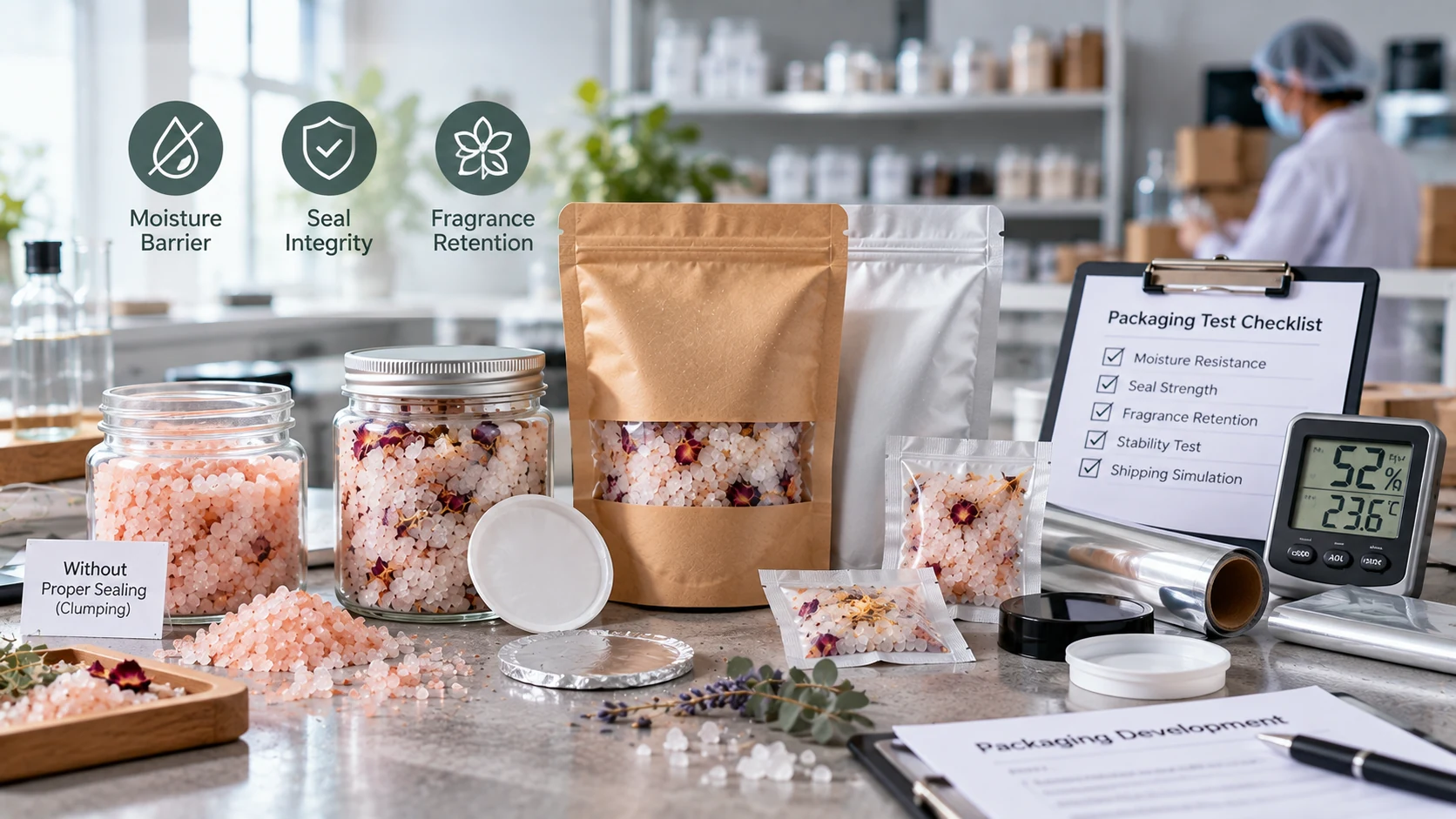
Bath salt packaging should be evaluated for moisture protection before mass production.
A package may look acceptable in a short sample review but perform differently after longer storage or transportation through humid environments.
- Moisture exposure can contribute to:
- clumping;
- reduced flowability;
- changes in crystal appearance;
- fragrance changes;
- botanical or color instability.
For flexible packaging, barrier performance depends on the full film structure.
For rigid jars, the container, cap, liner and seal should be evaluated as one system.
Common sealing approaches can include heat sealing, induction seals, inner liners or other closure systems depending on the packaging format.
The exact solution should be confirmed with the final formula and pack.
7. Fragrance Retention Also Depends on Packaging
Fragrance is not only a formula issue.
A scented bath salt needs packaging that helps maintain the intended fragrance profile throughout storage.
This becomes particularly important when the product contains essential oils, fragrance blends or botanicals that contribute to the sensory experience.
Packaging material, seal integrity and headspace can all influence how the product smells when the consumer eventually opens it.
For this reason, fragrance evaluation should not end with the formula sample.
The product should be checked in its intended commercial packaging.
For deeper formulation considerations, see our Bath Salt Formula Guide.
8. Gift Sets Need Both Presentation and Protection
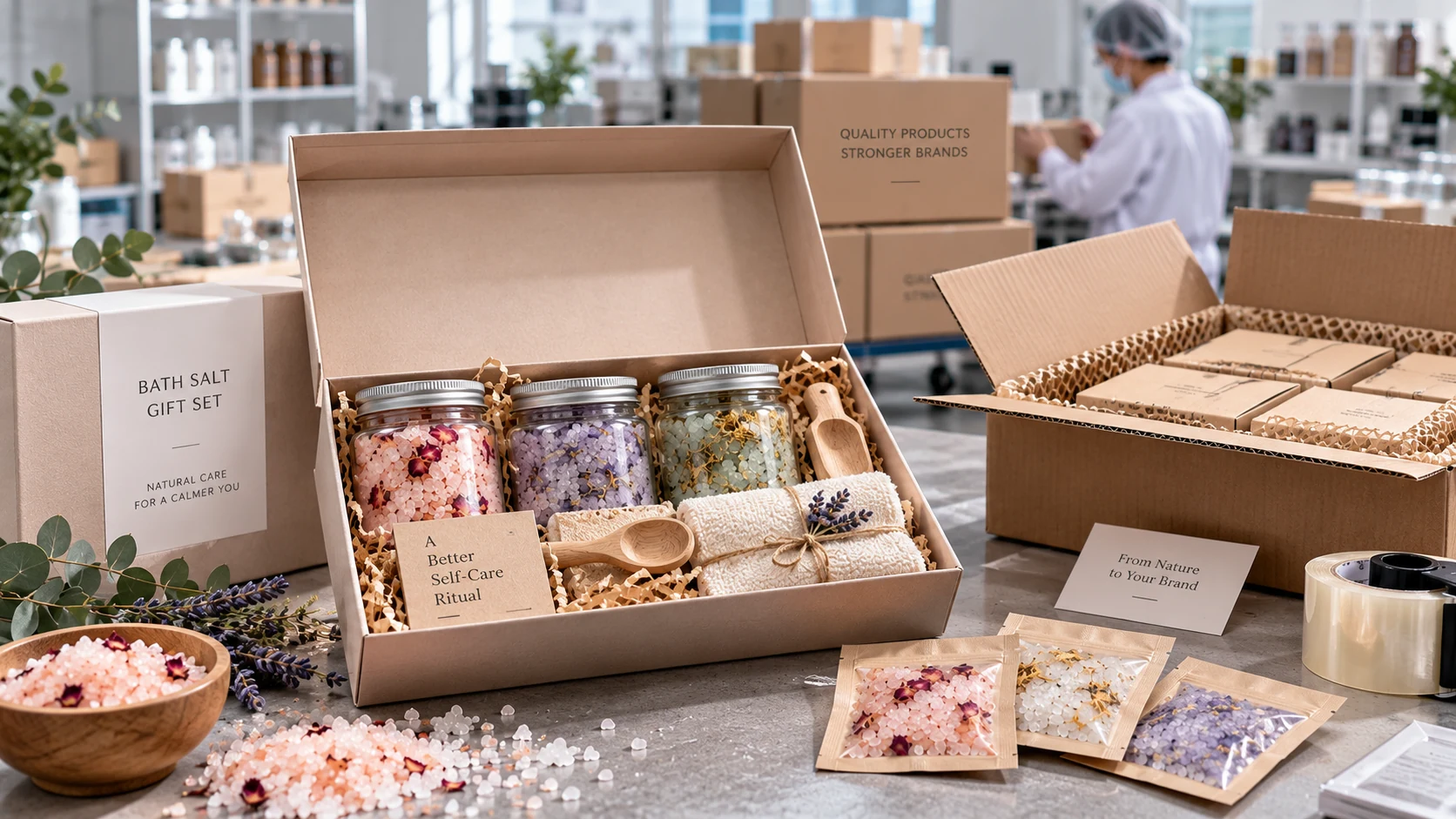
Custom bath gift sets can combine multiple fragrances, jars, sachets or complementary body-care products.Bath salt gift sets can combine multiple fragrances, jars, sachets or complementary body-care products.
The outer box creates the presentation, but it should not be relied on as the primary moisture barrier.
Each bath salt product still needs suitable inner packaging.
For multi-piece sets, brands should also consider how products move inside the box during shipping. Inserts, dividers or molded trays may be needed to reduce movement and protect glass components.
A good gift-set structure therefore combines:
inner product protection + presentation + shipping stability
rather than focusing only on decorative packaging.
9. Choose Packaging Based on the Sales Channel
The same bath salt formula may require different packaging depending on where it will be sold.
An e-commerce brand may prioritize low shipping weight and resistance to breakage.
A premium spa collection may place greater value on a glass jar and visible crystal presentation.
Retail products need strong shelf presence, while hotel or sampling programs may require compact single-use formats.
The sales channel should therefore be discussed early in packaging development.
Packaging is part of the commercial product specification-not something that should be selected only after the formula has already been finalized.
10. What Should Be Approved Before Packaging Goes Into Production?
Before final packaging production begins, brands should confirm more than the artwork.
The approved specification should include the packaging format, dimensions, material structure, closure, sealing method, fill weight, label or print requirements and carton configuration.
The manufacturer should also confirm that the package has been evaluated with the final bath salt formula.
This is especially important when the product contains fragrance, botanicals or moisture-sensitive mineral systems.
Once both the formula and packaging are approved, the project can move into commercial filling and production.
The detailed factory process will be covered separately in our Bath Salt Manufacturing Process guide.
Frequently Asked Questions
Q: 1. What is the best packaging for bath salts?
A: There is no single best format. Jars provide stronger premium presentation, pouches offer better freight and storage efficiency, and sachets work well for samples and single-use formats. The final decision should reflect the formula, sales channel, positioning and shipping requirements.
Q: 2. Are jars better than pouches for bath salts?
A: Not necessarily. Jars can create a more premium experience, especially when the salt itself is visually attractive. Pouches are usually lighter and more efficient to ship. Both can work well when the material and sealing system provide suitable protection.
Q: 3. How can packaging help prevent bath salts from clumping?
A: Moisture control depends on the barrier properties of the packaging and the quality of the seal or closure. The formula, packaging material, sealing method and expected storage environment should be evaluated together.
Q: 4. Can bath salt packaging be customized?
A: Yes. Private label projects can use custom printed pouches, labels, jars, cartons and gift-set structures. The level of customization usually affects MOQ, tooling, lead time and packaging cost.
Q: 5. Should bath salt packaging be tested with the finished formula?
A: Yes. Packaging should ideally be evaluated with the final salt blend, fragrance, botanicals and color because these components can influence long-term product and packaging compatibility.
Build Packaging Around the Product, Not the Other Way Around
Bath salt packaging should protect the formula while supporting the intended brand position and sales channel.
A premium jar, lightweight pouch or compact sachet can all be effective when the format is selected for the right commercial reason.
The most reliable development process evaluates packaging together with moisture behaviour, fragrance, filling, shipping and final retail presentation.
Poleview supports private label bath salt projects from formula development and packaging selection through filling, quality control and commercial production.
Brands ready to evaluate production options can explore our private label bath salts manufacturing services.