

Choosing the right body scrub packaging involves more than selecting an attractive container. The package must work with the formula, allow convenient dispensing, maintain reliable closure performance, and protect the product during storage and transportation.
For private label brands developing sugar scrubs, salt scrubs, coffee scrubs, and cream-based exfoliators, packaging decisions should be made alongside formulation development. Particle size, oil content, viscosity, and product texture all influence whether a jar or tube is suitable.
This guide explains how to compare body scrub jars and tubes, select appropriate sealing components, and evaluate leakage risks before approving packaging for production.
How to Choose Body Scrub Packaging for Your Formula
The first step in choosing body scrub packaging is understanding the physical characteristics of the finished product.
A dense sugar scrub may be easy to scoop from a wide-mouth jar but difficult to squeeze through a narrow tube opening. A finer cream-based scrub may offer more dispensing options, provided its viscosity and particle characteristics are suitable.
Oil content also matters. Oil-rich formulas require careful evaluation of closure liners, sealing surfaces, and container compatibility.
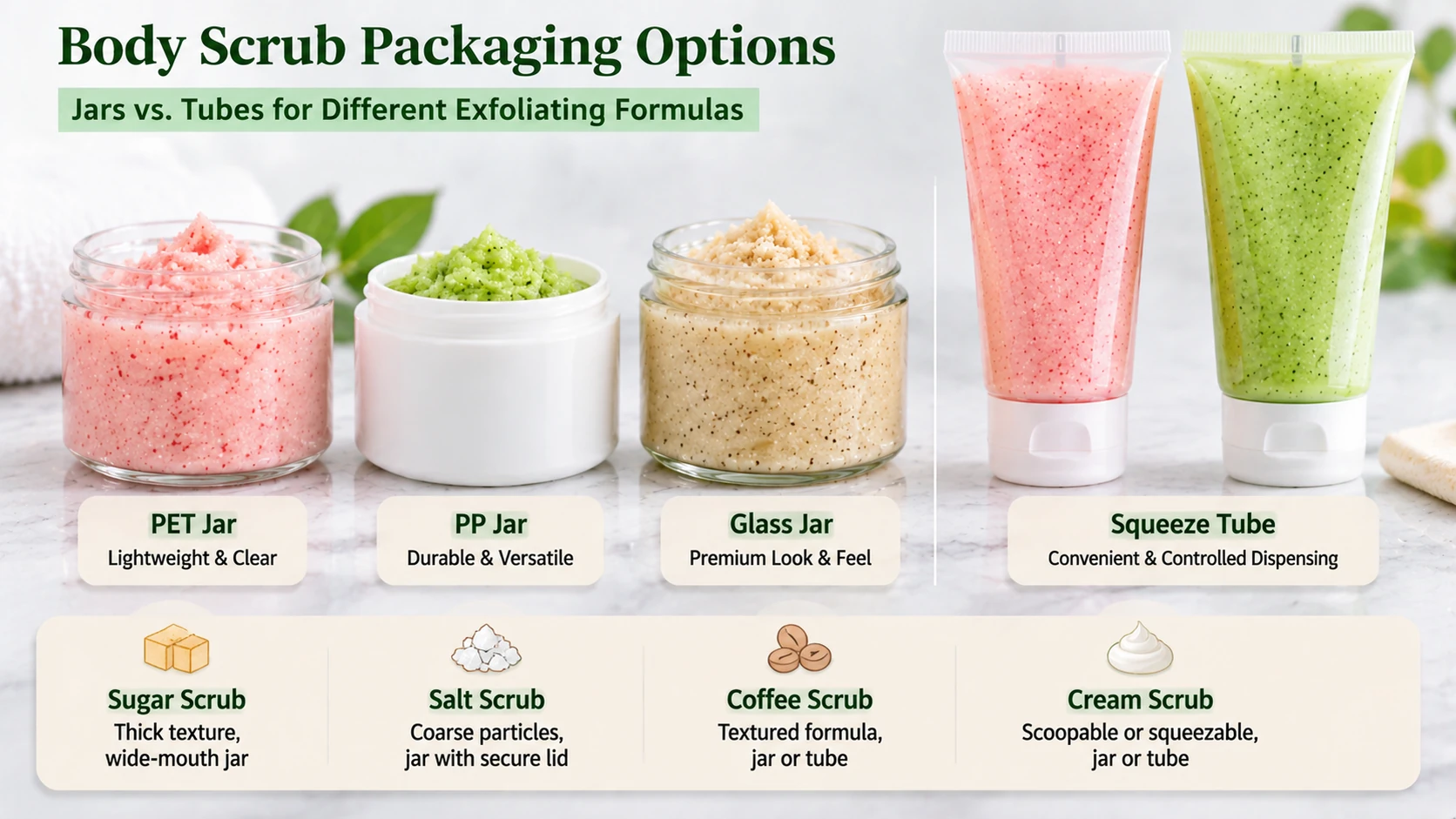
Match Packaging to Different Body Scrub Formulas
| Formula Type | Packaging to Evaluate | Main Development Check |
|---|---|---|
| Thick sugar scrub | Wide-mouth jar | Oil migration and closure cleanliness |
| Coarse salt scrub | Wide-mouth jar with secure lid | Particle access and material compatibility |
| Coffee scrub | Jar; tube where dispensing permits | Particle accumulation and separation |
| Cream-based scrub | Jar or squeeze tube | Viscosity and dispensing consistency |
| Fine-particle cleansing scrub | Suitable squeeze tube or jar | Outlet blockage and cap closure |
These are starting points rather than universal rules. A fine coffee scrub may work in a suitable tube, while a high-solids sugar scrub may require a jar even when its particles are relatively small.
Packaging decisions should start with a clear understanding of the formula's exfoliating particles, base system and texture. For more information on these formulation factors, read our Body Scrub Formula Guide for Private Label Brands.
Consider How Customers Will Use the Product
Body scrubs are often used in wet bathroom environments, sometimes with wet or oily hands. The lid should be easy to grip, the container should be comfortable to hold, and the remaining product should be accessible.
The sales channel also influences packaging decisions. Retail products may prioritize shelf presentation and case packing, while e-commerce products need packaging that can withstand parcel handling and transportation.
The complete filled pack should therefore be evaluated under conditions relevant to both consumer use and distribution.
Body Scrub Jars: A Practical Choice for Thick & Textured Formulas
Body scrub jars provide direct access to the formula, making them a practical option for dense textures and larger exfoliating particles.
A wide opening allows customers to scoop the desired amount without forcing the scrub through a narrow dispensing outlet.
However, jar capacity alone does not determine suitability. Opening diameter, container shape, lid grip, thread design, and liner construction all influence performance.
The jar and closure should be evaluated as one complete packaging system.
Plastic vs. Glass Body Scrub Jars
Plastic and glass offer different packaging characteristics.
Plastic jars, including PET and PP options, can provide lighter packaging and reduced breakage exposure compared with glass. Their suitability depends on the specific material grade, container construction, and compatibility with the complete formula.
Glass jars can provide a substantial feel and premium appearance, but their weight and breakage risk should be considered, particularly for products used in wet bathroom environments.
Decorative metal closures also require attention to their internal construction and protection against direct formula contact.
| Material | Potential Advantage | Main Consideration |
|---|---|---|
| PET jar | Clear product presentation | Validate compatibility with the complete formula |
| PP jar | Opaque and translucent design options | Assess rigidity, appearance, and closure fit |
| Glass jar | Premium appearance and substantial feel | Consider weight, breakage, and handling |
| Plastic jar with decorative closure | Flexible styling options | Check internal materials and sealing performance |
No material should be assumed suitable for every body scrub. Compatibility should be assessed using the finished formula and final packaging components.
Confirm Net Weight With a Fill Trial
Jar volume and product weight are different measurements.
A nominal 250 mL container does not automatically hold a commercially suitable 250 g fill of every body scrub formula.
Density, particle packing, entrapped air, and filling conditions can affect the product level.
A fill trial should confirm:
- Declared net weight.
- Product appearance and fill level.
- Suitable headspace.
- Clearance beneath the closure.
- Cleanliness of the jar lip and sealing surface.
- Filling consistency during production.
This helps avoid packaging problems that may only become apparent after the product moves into bulk filling.
Body Scrub Tubes: Controlled Dispensing for Suitable Formulas
Body scrub tubes offer convenient dispensing and reduce the need for customers to place their fingers directly into the product.
They are worth evaluating for fine-particle scrubs, creamy exfoliators, and shower-focused product ranges.
The main consideration is whether the formula can be dispensed consistently throughout the package.
A tube that works with a fresh sample may become difficult to use after storage if the scrub thickens, separates, or develops particle accumulation near the opening.
Match the Tube Opening to the Formula
Particle size, particle loading, viscosity, and possible particle agglomeration all influence dispensing performance.
A larger outlet may help accommodate certain exfoliating particles, but it cannot resolve every formula-related issue.
The tube must also allow customers to squeeze out the product comfortably without dispensing an uneven mixture of oil and solids.
During development, evaluate the proposed tube with the final cap and a production-representative formula.
Check:
- Initial dispensing performance.
- Squeeze force and product flow.
- Particle accumulation near the outlet.
- Consistency during repeated use.
- Access to the remaining product.
- Residue around the opening and cap closure.
A tube should be approved based on actual dispensing performance rather than appearance alone.
Compare Body Scrub Jars and Tubes
The most useful comparison is based on the formula and intended product experience.
| Selection Factor | Body Scrub Jars | Body Scrub Tubes |
|---|---|---|
| Product access | Direct scooping | Squeezing through an outlet |
| Formula starting point | Dense textures and larger particles | Squeezable textures and finer particles |
| Main usability concern | Lid grip and access to remaining product | Squeeze force and consistent flow |
| Closure concern | Product on threads or sealing surfaces | Residue around the outlet or cap |
| Potential leakage locations | Jar mouth, liner, and lid | Cap, shoulder, seams, and end seal |
| Main approval priority | Complete jar-and-closure performance | Dispensing and complete tube integrity |
A jar is not automatically more secure than a tube, and a tube is not automatically cleaner in use. Both require validation with the selected formula and closure.
Body Scrub Seals: Protection Before & After Opening
Body scrub seals can serve different purposes, including providing a barrier before first use, supporting resealing, or showing visible evidence that a package has been opened.
These functions should not be confused.
For example, a shrink band can provide visible evidence of opening, but it does not seal the jar mouth against escaping oil. A loose inner disc may improve presentation without providing a bonded barrier.
Brands should specify the actual sealing function required rather than simply requesting a safety seal.
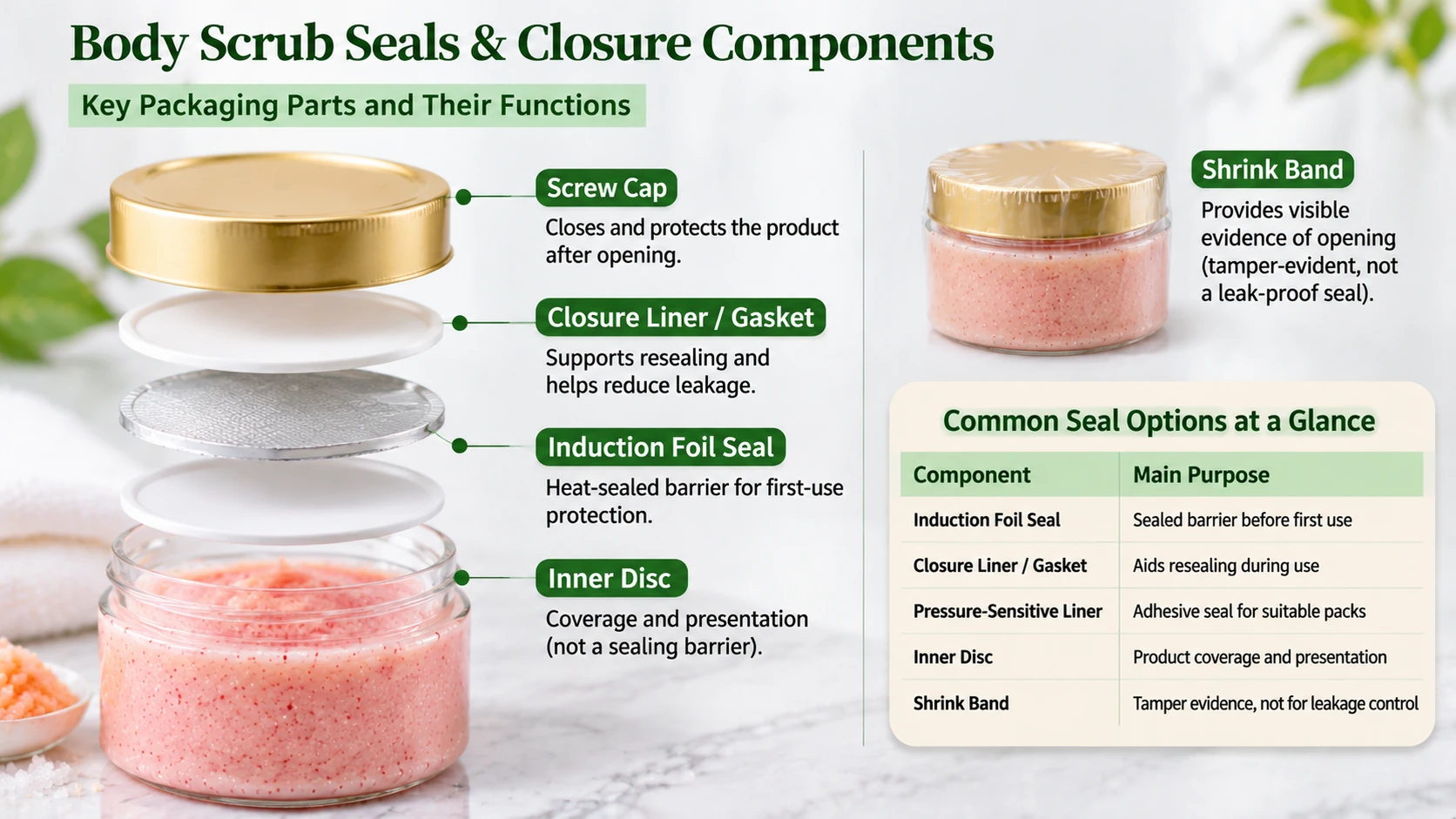
Induction Seals, Liners & Inner Discs
Different sealing components offer different functions.
| Seal or Closure Component | Primary Purpose | What Brands Should Verify |
|---|---|---|
| Induction foil seal | Bonded barrier across the opening before first use | Material compatibility and continuous seal formation |
| Closure liner or gasket | Support resealing after opening | Fit, formula compatibility, and repeated-use performance |
| Pressure-sensitive liner | Adhesive-based sealing for suitable applications | Adhesion and performance with the actual formula and container |
| Loose inner disc | Cover the product and support presentation | Fit and ease of handling |
| Shrink band | Provide visible evidence of opening | Secure application and clear visibility |
An induction foil seal requires a compatible heat-seal layer, container sealing surface, closure system, and application conditions.
After the initial seal is removed, the lid and any resealing liner must perform on their own. This makes repeated-use evaluation important, especially for products handled with oily or wet hands.
Keep the Jar Lip Clean During Filling
Oil or scrub particles on the sealing surface can interfere with seal formation.
A cap may appear correctly fitted while residue beneath the seal creates an incomplete barrier.
Clean filling and controlled closure application should therefore be included in packaging development.
Tightening the lid further is not a reliable substitute for a suitable liner, clean contact surfaces, and validated sealing conditions.
How to Reduce Body Scrub Leakage
Body scrub leakage can arise from the formula, packaging components, filling process, or distribution conditions.
Some packaging leakage issues may be associated with formula instability, including oil separation and changes in product consistency. For a closer look at these formulation challenges, see our Common Body Scrub Formula Problems Guide.
An oil-rich scrub may release a mobile oil phase, while an unsuitable liner or contaminated sealing surface may provide a route for that oil to escape.
The first step is to identify where the leakage occurs and under what conditions it appears.
For example, leakage after warm storage may require a different investigation from damage following parcel handling.

Check Formula Stability and Packaging Compatibility Together
Packaging cannot fully compensate for a formula that behaves differently from the approved sample.
If separation develops during storage, evaluate whether it is acceptable for the product concept and how it affects the closure and consumer experience.
Filled-pack testing should examine:
Changes in appearance and texture.
Oil migration and phase separation.
Container and closure condition.
Seal integrity and leakage.
Label and decoration performance.
Dispensing after storage.
The final fragrance and formula combination should also be included because ingredient changes may affect packaging compatibility.
Validate the Final Pack Before Production Approval
Packaging approval should use the intended fill weight, container, closure, liner, seal, decoration, and shipping configuration.
A successful result with one jar size or liner should not automatically be applied to another.
A practical evaluation plan may include:
- Compatibility checks: Inspect the container, closure, liner, label, and decoration after contact with the finished formula.
- Seal inspection: Look for incomplete bonding, residue, channels, or inconsistent opening.
- Orientation checks: Evaluate upright, side-stored, and inverted packs under agreed conditions.
- Shipping evaluation: Assess the finished shipping pack against the intended distribution route.
- Repeated-use assessment: Dispense and reclose the product after removing the initial seal.
Acceptance criteria should be agreed before testing. Define what counts as unacceptable leakage, separation, label damage, dispensing difficulty, or closure failure.
This creates a more reliable approval process than relying on a general statement that a sample looks fine.
Custom Body Scrub Packaging: Branding That Works in Use
Custom body scrub packaging can include container colors, printed decoration, labels, lid finishes, and outer cartons.
These choices should communicate the brand while remaining practical for the formula and its intended use environment.
A premium design also needs readable information and comfortable handling. Consider whether the container shape supports easy opening and whether the decoration remains presentable after contact with water, oil, and wet hands.
For a broader overview of packaging options across body wash, body lotion, body butter and other personal care products, explore our Body Care Packaging Guide for Private Label Brands.
Choose Labels for Bathroom Conditions
A water-resistant label face material does not guarantee that the complete label will perform well.
Adhesive, ink, coating, application quality, and container surface all contribute to durability.
Evaluate labels on filled packs. Check for lifting edges, staining, print transfer, and reduced readability after realistic handling.
Transparent containers also need a design review with the actual scrub inside because formula color and particle distribution can change the finished appearance.
Compare the Complete Packaging Cost
Private label scrub packaging costs extend beyond the jar or tube.
Closures, seals, decoration, filling, assembly, protective materials, and shipping weight all influence the finished cost.
For an initial launch, compare an existing container with customized decoration against more extensive customization.
Request quotations using the same fill weight, seal specification, and packing requirements. This makes it easier to understand whether price differences come from branding choices, functional components, or shipping requirements.
What to Include in a Private Label Scrub Packaging Brief
A clear packaging brief helps manufacturers propose suitable options and prepare relevant samples.
Include how the formula behaves and how customers will use it, alongside the desired appearance.
The most useful information includes:
- Product details: Scrub type, texture, particle size, fragrance, and any known separation behavior.
- Packaging specification: Target net weight, preferred jar or tube, material, closure, and seal requirements.
- Design direction: Brand colors, reference images, artwork, and decoration preferences.
- Commercial requirements: Target market, sales channel, estimated quantity, budget, and launch timing.
- Approval expectations: Filled samples, compatibility evaluation, leakage checks, and shipping-pack assessment.
Ask suppliers to identify what is included in their proposal and what still requires confirmation. Minimum order quantities, sampling arrangements, component availability, and testing scope should be clarified for the selected packaging route.
Frequently Asked Questions
Q: 1. What is the best packaging for body scrub?
A: The best packaging depends on texture, particle size, oil content, and intended use. Wide-mouth jars are practical for dense or coarse scrubs. Tubes can suit finer, squeezable formulas when dispensing and closure performance have been validated.
Q: 2. Are jars or tubes better for sugar scrub?
A: Jars are a useful starting point for thick or coarse sugar scrubs. Tubes may work for suitably formulated sugar scrubs, but the complete formula must dispense consistently without blocking the outlet or preventing cap closure.
Q: 3. Can coffee scrub be packaged in a tube?
A: Yes, if the particle size and formula texture suit the tube. Evaluate squeeze force, particle accumulation, separation, and dispensing throughout the pack. Coarser coffee scrubs may be easier to use from jars.
Q: 4. What causes body scrub packaging leakage?
A: Possible causes include oil separation, unsuitable liners, product residue on sealing surfaces, damaged components, incorrect closure application, or shipping damage. Identifying the leakage location helps determine which checks are needed.
Q: 5. Do body scrub jars need an induction seal?
A: Not every jar requires one. The decision depends on the formula, container, closure, shipping route, and first-opening protection required. Where an induction seal is selected, its materials and sealing process must be validated.
Q: 6. Does an inner lid prevent body scrub leakage?
A: A loose inner disc should not be assumed to prevent leakage. It serves a different function from a bonded foil seal or a compatible closure liner. Confirm how each component performs in the complete package.
Q: 7. Can the same jar be used for sugar, salt, and coffee scrubs?
A: Potentially, but each formula should be evaluated separately. Differences in particles, oils, fragrance, and texture can affect compatibility, sealing, and usability, even when the container is unchanged.
Q: 8. What affects the MOQ for custom body scrub packaging?
A: MOQ depends on the container, closure, decoration method, custom color requirements, and whether new tooling is needed. Confirm both packaging-component and finished-product requirements when requesting a quotation.
Q: 9. What should I send when requesting a body scrub packaging quote?
A: Provide the scrub type, target net weight, preferred container, reference images, target market, estimated order quantity, and seal expectations. If available, include a formula sample or details about texture and particle size.
Develop Your Body Scrub Packaging with Poleview
At Poleview Group, we support private label body scrub projects with customized formula and packaging options. Explore our private label body scrub manufacturing services and share your formula direction, target net weight, packaging references, and estimated order quantity.