

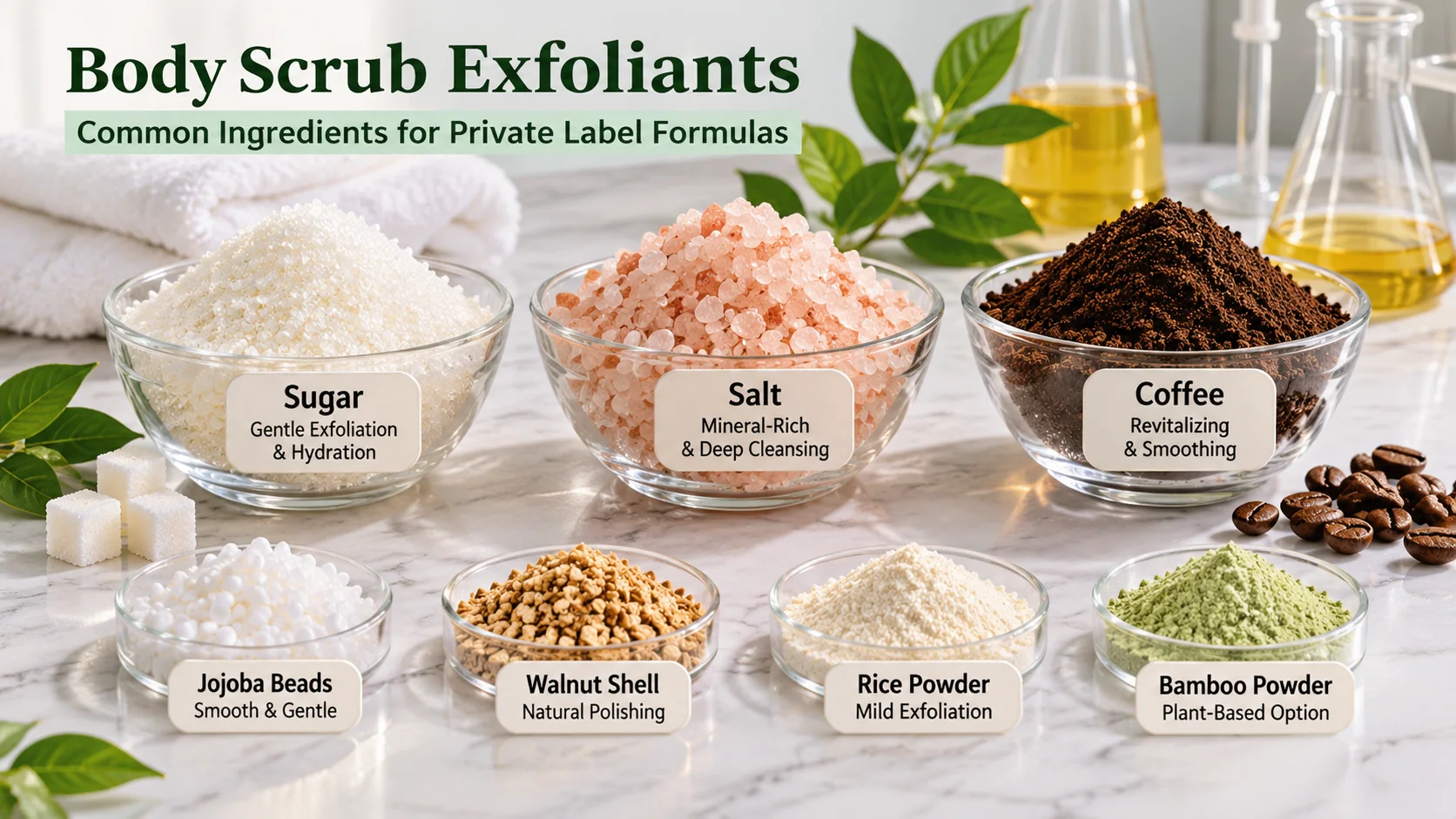
A successful body scrub formula is about more than choosing sugar, salt, or coffee as an exfoliant. The base system, particle characteristics, oil content, and overall texture all influence how the product feels during application and how easily it rinses away.
For private label brands, these decisions affect product positioning, customer experience, packaging requirements, and manufacturing consistency.
This guide explains the key factors behind body scrub formulation, helping brands make informed decisions before developing a custom exfoliating product.
For a broader overview of body scrub product types, market positioning and private label development, explore our Private Label Body Scrub Guide.
What Makes a Good Body Scrub Formula?
A well-designed body scrub should provide the intended exfoliating experience while remaining comfortable to apply, easy to distribute, and suitable for its recommended use.
Four elements deserve particular attention during formulation:
Exfoliating particles determine the physical exfoliation experience. Their size, shape, hardness, and concentration influence how the scrub feels on the skin.
Base systems control spreadability, lubrication, rinsing behavior, and the amount of residue left after use.
Texture and consistency influence how easily the product can be scooped, spread, and handled during filling.
Stability and safety determine whether the formula maintains its intended characteristics during storage and normal use.
These elements need to work together. A formula with attractive ingredients may still perform poorly if the particles are uncomfortable, the base feels excessively greasy, or the texture changes during storage.
Choosing the Right Exfoliating Ingredients
The choice of exfoliant is one of the first decisions in body scrub development. Different particles provide different sensory experiences, and their behavior can change depending on the formula.
Sugar Scrub Formulas
Sugar is widely used in body scrubs because it provides recognizable physical exfoliation and gradually dissolves when exposed to water.
Sugar scrubs can be developed with rich oil-based textures or emulsified systems that offer a cleaner rinsing experience.
However, water content must be considered carefully. Premature sugar dissolution can change particle size, texture, and the overall exfoliating experience during storage.
Salt Scrub Formulas
Salt is another popular choice for body exfoliation, particularly in spa-inspired and foot-care products.
Crystal size and shape significantly affect the application experience. Coarser particles may feel more abrasive, while finer grades can produce a smoother texture.
Because salt can cause discomfort on irritated or broken skin, the intended application area and appropriate usage instructions should be considered during development.
Coffee Scrub Formulas
Coffee grounds provide a distinctive appearance, recognizable aroma, and natural ingredient story.
For brands developing coffee-based exfoliating products, raw material quality is particularly important. Particle uniformity, residual oil content, moisture, color, and odor stability can affect the finished formula.
Coffee scrubs are often paired with emollient bases to improve spreadability and reduce excessive friction during application.
Other Exfoliating Options
Brands may also explore finely processed botanical powders, suitable mineral particles, or other cosmetic-grade exfoliants.
Material selection should consider physical performance, ingredient safety, supplier specifications, and applicable environmental restrictions in the target market.
For products sold in the European Union, the restrictions on intentionally added synthetic polymer microparticles are especially relevant when evaluating certain exfoliating materials.
Body Scrub Base Systems Explained
The exfoliating particles are only one part of the formula. The base determines how the scrub spreads across the skin, carries the particles, and behaves when exposed to water.
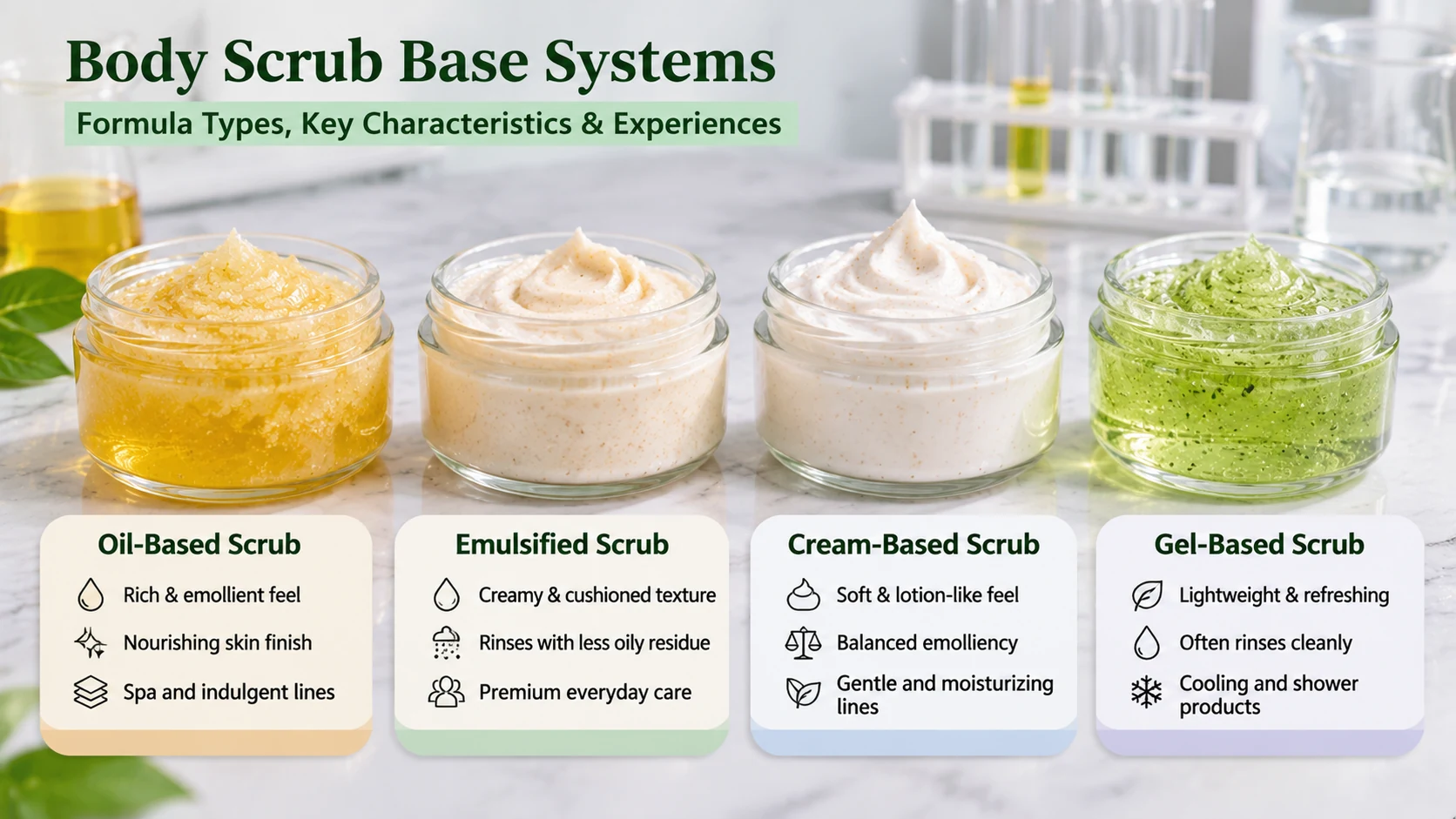
The following systems are commonly considered during private label development.
| Base System | Typical Skin Feel | Rinsing Experience | Product Positioning |
|---|---|---|---|
| Oil-Based Scrub | Rich and emollient | May leave an oily film | Spa and indulgent body care |
| Emulsified Scrub | Creamy and cushioned | Often rinses with less oily residue | Premium everyday body care |
| Cream-Based Scrub | Soft and lotion-like | Depends on the emulsion system | Gentle-feeling body care |
| Gel-Based Scrub | Lightweight and fresh | Often rinses cleanly | Refreshing shower products |
These are general formulation characteristics. Actual performance depends on the complete ingredient system.
Oil-Based Body Scrubs
Oil-based scrubs typically combine exfoliating particles with vegetable oils, esters, butters, or other emollients.
They can provide a rich application experience and help reduce friction between the particles and the skin.
However, oil selection influences spreadability, oxidation resistance, temperature behavior, and the amount of residue remaining after rinsing.
For brands targeting a luxurious, moisturizing experience, an oil-based system may be appropriate. The formula should still be evaluated for texture consistency and packaging compatibility.
Emulsified Body Scrubs
Emulsified scrubs use an emulsifying system to help oil-based components disperse when the product comes into contact with water.
Depending on the formula, this can create a creamy or milky rinsing effect and reduce the heavy residue associated with some traditional oil scrubs.
Emulsified formulas are often considered by brands seeking a balance between a rich texture and a more convenient shower experience.
The emulsifier system, emollient composition, and particle loading must be developed together to achieve the intended result.
Cream-Based and Gel-Based Scrubs
Cream-based scrubs combine exfoliating particles with an emulsion structure, creating a softer, lotion-like application experience.
Gel-based scrubs use a structured gel system to deliver a lighter texture. Their performance depends on the thickening system, particle characteristics, and compatibility with other ingredients.
Both systems may be suitable for specific product concepts, but they require careful evaluation of particle distribution and texture stability.
How Particle Size, Texture & Base Affect Performance
Two body scrubs can contain the same exfoliating ingredient and still feel completely different.
This is because physical exfoliation depends on more than the identity of the particles.
Particle Size and Shape
Particle size influences how noticeable the exfoliation feels, while particle shape and hardness affect the contact between the scrub and the skin.
Larger or irregular particles may produce a more pronounced scrubbing sensation. Smaller, more uniform particles can support a finer texture, although the complete formula determines the final experience.
Brands should evaluate different particle grades during sampling rather than assuming that one size works for every application.
Exfoliant Concentration
Increasing the proportion of exfoliating particles can make the formula feel more densely packed and change how it spreads.
However, a higher particle concentration does not automatically create a better product. Excessive loading may reduce spreadability, make filling more difficult, or create an uncomfortable application experience.
The appropriate concentration depends on the target texture, particle properties, and base system.
Viscosity and Particle Distribution
The structure of the base helps determine whether exfoliating particles remain evenly distributed.
A formula that is too fluid may allow dense particles to settle. A formula that is excessively thick may be difficult to scoop, spread, or fill.
Formulators therefore consider viscosity, yield behavior, and particle distribution together.
The goal is not simply to make the scrub thicker, but to create a texture that remains practical during manufacturing and use.
Formulating for Different Brand Positions
Body scrub formulation should begin with a clear product concept rather than a long list of fashionable ingredients.
A spa-inspired scrub may prioritize a rich oil system and a distinctive fragrance. A refreshing shower scrub may benefit from a lighter base and easier rinsing characteristics.
For brands focused on botanical ingredients, material traceability, ingredient quality, and environmental claims may be important.
Sensitive-skin-oriented products require particular attention to particle abrasiveness, fragrance selection, intended use, and appropriate safety evaluation. No scrub should be described as suitable for sensitive skin without adequate supporting evidence.
Additional ingredients such as glycerin, panthenol, selected emollients, or botanical extracts can be considered according to the chosen formula. Their suitability depends on compatibility, stability, and the intended cosmetic benefits.
A focused ingredient strategy is usually more effective than adding multiple ingredients that contribute little to the actual user experience.
Stability & Safety Considerations in Body Scrub Formulation
A body scrub formula must remain suitable for its intended use beyond the initial laboratory sample.
During development, manufacturers should evaluate the physical and microbiological risks associated with the finished formula.
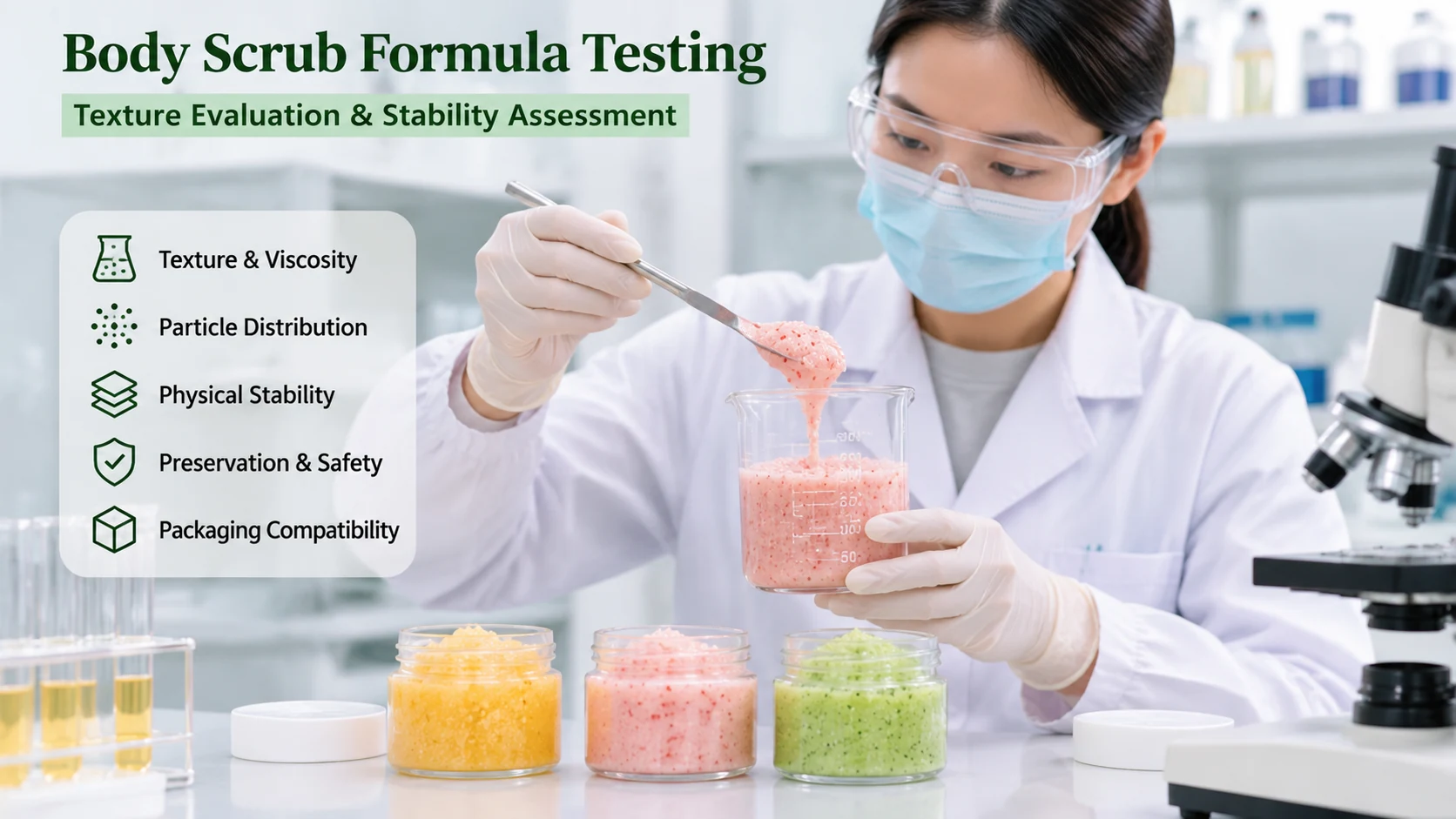
Important considerations include particle distribution, changes in viscosity, oil separation, color and odor stability, and compatibility with the selected container.
Preservation requirements also depend on the composition and expected usage conditions.
Water-containing formulas generally need an appropriate preservation strategy. Low-water or anhydrous formulas may present different risks, but they should not automatically be considered free from microbial concerns, especially when the product may be exposed to water during consumer use.
Suitable testing may include stability studies, microbiological assessments, preservative efficacy testing where appropriate, and packaging compatibility evaluations.
For a more detailed look at container selection, sealing structures and packaging compatibility, read our Body Care Packaging Guide for Private Label Brands.
For a closer look at common formulation failures, including oil separation, particle sinking, excessive greasy residue and texture changes, read our Common Body Scrub Formula Problems Guide.
The testing plan should reflect the formula, intended shelf life, distribution conditions, and target market requirements.
If an existing formula develops separation, particle settling, or unwanted texture changes, the causes should be investigated before the product proceeds to commercial production.
From Formula Brief to Approved Sample
For private label brands, effective body scrub development starts with a clear formulation brief.
Before sampling, it is useful to define the preferred exfoliating ingredient, target texture, rinsing experience, fragrance direction, packaging format, and intended retail market.
The manufacturer can then assess suitable base systems and develop prototypes for comparison.
During sample evaluation, brand owners should pay attention to how the formula looks in the container, how easily it spreads, how the exfoliating particles feel, and whether the after-feel matches the product concept.
Feedback from these evaluations helps guide formulation adjustments.
Once a formula is selected, appropriate testing and manufacturing trials help determine whether the product can be produced consistently at the required scale.
At Poleview Group, we work with private label and OEM/ODM customers to develop customized body care products based on their formulation goals, packaging preferences, and target markets.
Frequently Asked Questions
Q: 1. Which exfoliating ingredient is best for a private label body scrub?
A: There is no single best ingredient. Sugar, salt, coffee, and other cosmetic-grade particles offer different sensory characteristics. The choice depends on the intended application, particle properties, base system, and brand positioning.
Q: 2. What is the difference between oil-based and emulsified body scrubs?
A: Oil-based scrubs generally provide a richer, more emollient application experience. Emulsified scrubs use an emulsifying system to improve oil dispersion during rinsing, often reducing the oily after-feel. Actual results depend on the complete formula.
Q: 3. Can a body scrub be formulated to feel less greasy?
A: Yes. Adjusting the emollient composition, emulsifying system, and overall formula structure can help achieve a lighter after-feel. This should be evaluated through prototype testing.
Q: 4. How can brands evaluate particle distribution in a scrub?
A: Particle distribution can be assessed by examining samples taken from different areas of the product and monitoring changes during stability testing. Manufacturers may also evaluate viscosity and structural behavior to understand how the base supports the particles.
Q: 5. Can the exfoliation level be customized?
A: Yes. Exfoliation intensity can be adjusted through particle selection, size, shape, concentration, and the surrounding base. Samples should be evaluated for both sensory performance and appropriate skin compatibility.
Develop a Custom Body Scrub Formula with Poleview
A successful private label body scrub begins with the right balance of exfoliating particles, base composition, texture, and stability.
Choosing these elements together helps brands create a distinctive product experience while reducing avoidable formulation challenges during development.
Whether you are planning a sugar scrub, salt scrub, coffee scrub, or customized emulsified scrub, Poleview Group can discuss suitable formulation options for your product concept.
Explore our private label body scrub manufacturing services to learn more about our product customization, packaging and OEM/ODM production support.